Showing posts with label network forensics. Show all posts

Wednesday, July 21, 2021

How does ARP work?

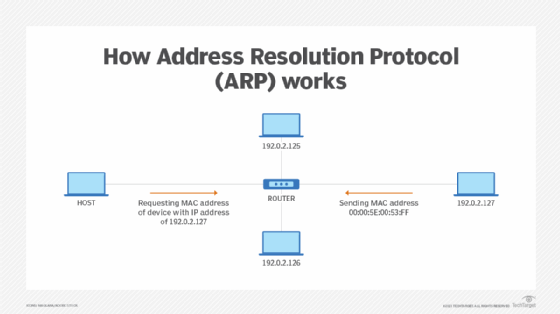
  •  How ARP works

When a new computer joins a LAN, it is assigned a unique IP address to use for identification and communication

When an incoming packet destined for a host machine on a particular LAN arrives at a gateway, the gateway asks the ARP program to find a MAC address that matches the IP address

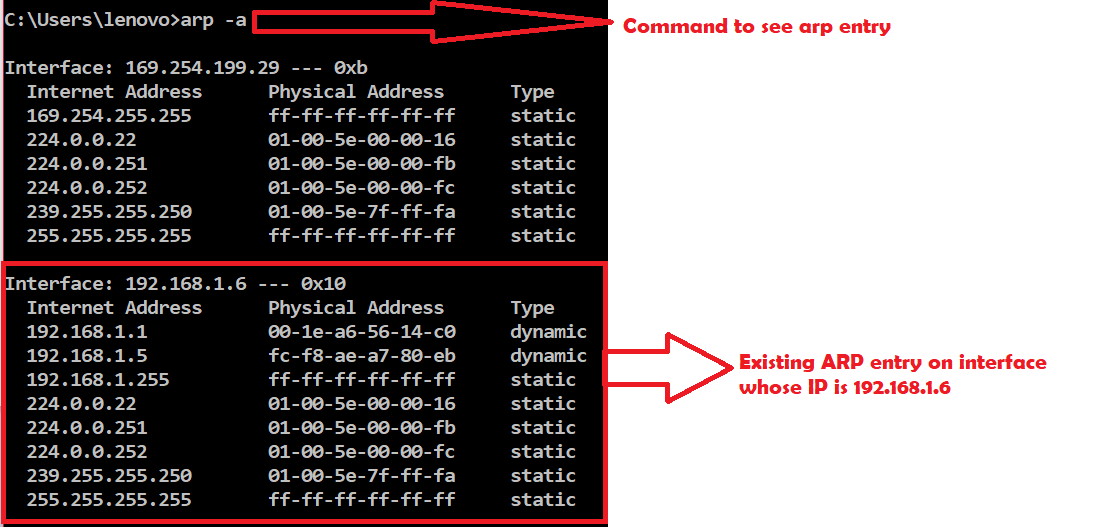
A table called the ARP cache maintains a record of each IP address and its corresponding MAC address.

All operating systems in an IPv4 Ethernet network keep an ARP cache.

Every time a host requests a MAC address in order to send a packet to another host in the LAN, it checks its ARP cache to see if the IP to MAC address translation already exists.

If the translation does not already exist, then the request for network addresses is sent and ARP is performed.


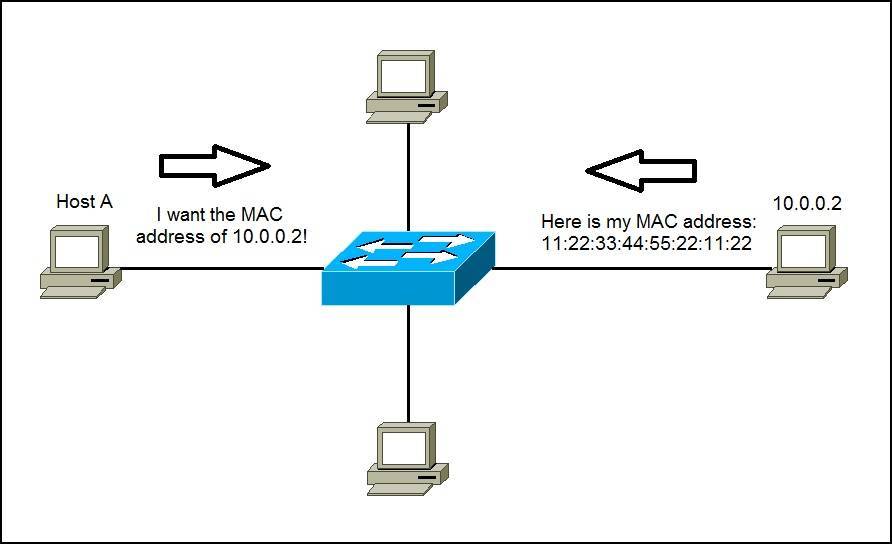
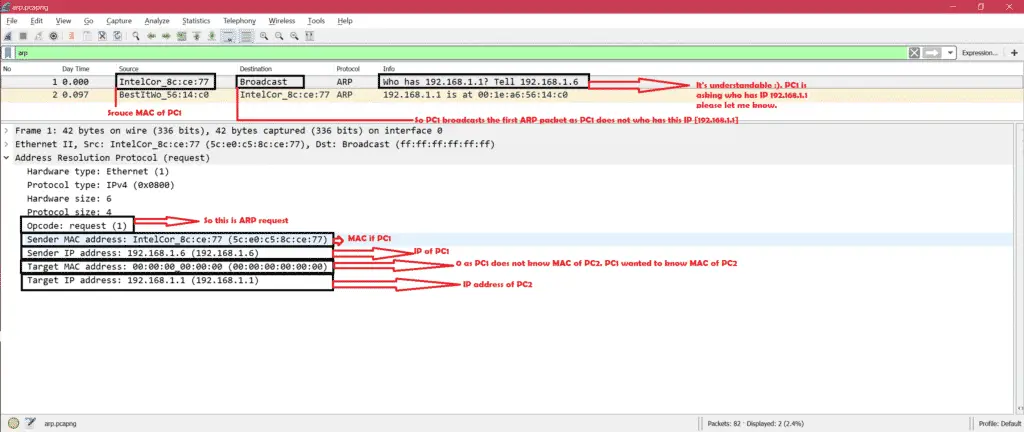
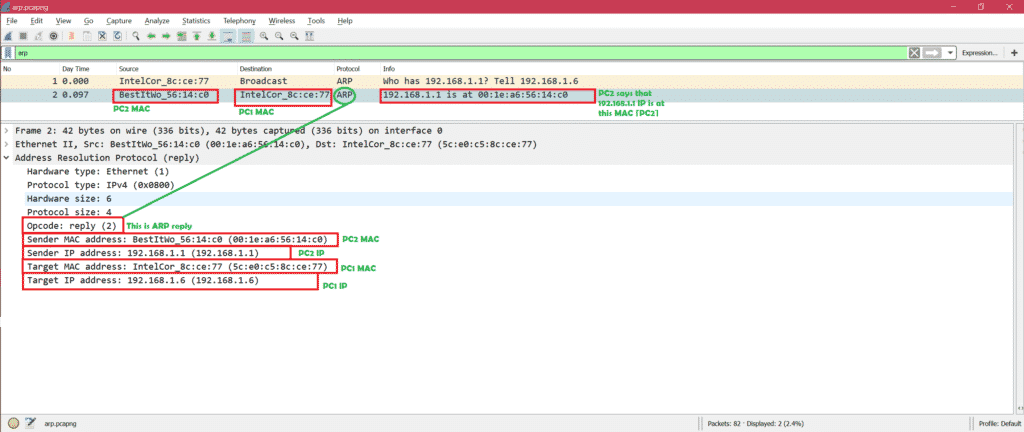
ARP broadcasts a request packet to all the machines on the LAN and asks if any of the machines know they are using that particular IP address. When a machine recognizes the IP address as its own, it sends a reply so ARP can update the cache for future reference and proceed with the communication.


Host machines that don't know their own IP address can use the Reverse ARP (RARP) protocol for discovery.


When an ARP inquiry packet is broadcast, the routing table is examined to find which device on the LAN can reach the destination fastest. This device, which is often a router, becomes a gateway for forwarding packets outside the network to their intended destinations.


ARP spoofing and ARP cache poisoning

Any LAN that uses ARP must be wary of ARP spoofing, also referred to as ARP poison routing or ARP cache poisoning.

ARP spoofing is a device attack in which a hacker broadcasts false ARP messages over a LAN in order to link an attacker's MAC address with the IP address of a legitimate computer or server within the network. Once a link has been established, the target computer can send frames meant for the original destination to the hacker's computer first as well as any data meant for the legitimate IP address.


https://searchnetworking.techtarget.com/definition/Address-Resolution-Protocol-ARP


ARP Request

ARP Reply

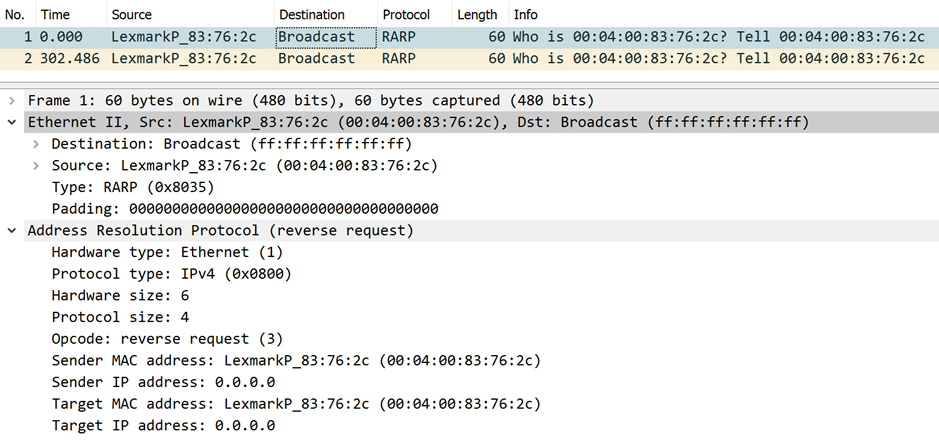
  • RARP: Its opposite of normal ARP that we have discussed. That means you have MAC address of PC2 but you do not have IP address of PC2. Some specific cases need RARP.

https://linuxhint.com/arp_packet_analysis_wireshark/

  • The Reverse Address Resolution Protocol (RARP) is an obsolete computer communication protocol used by a client computer to request its Internet Protocol (IPv4) address from a computer network, when all it has available is its link layer or hardware address, such as a MAC address. The client broadcasts the request and does not need prior knowledge of the network topology or the identities of servers capable of fulfilling its request.

https://en.wikipedia.org/wiki/Reverse_Address_Resolution_Protocol


  • Configuring Gratuitous ARP
Gratuitous Address Resolution Protocol (ARP) requests help detect duplicate IP addresses.
A gratuitous ARP is a broadcast request for a router’s own IP address. If a router or switch sends an ARP request for its own IP address and no ARP replies are received, the router- or switch-assigned IP address is not being used by other nodes

However, if a router or switch sends an ARP request for its own IP address and an ARP reply is received, the router- or switch-assigned IP address is already being used by another node.


https://www.juniper.net/documentation/us/en/software/junos/multicast-l2/topics/task/interfaces-configuring-gratuitous-arp.html

  • Gratuitous ARP
Gratuitous ARP could mean both gratuitous ARP request or gratuitous ARP reply. Gratuitous in this case means a request/reply that is not normally needed according to the ARP specification (RFC 826) but could be used in some cases. 

A gratuitous ARP request is an AddressResolutionProtocol request packet where the source and destination IP are both set to the IP of the machine issuing the packet and the destination MAC is the broadcast address ff:ff:ff:ff:ff:ff.

Gratuitous ARPs are useful for four reasons:

They can help detect IP conflicts. When a machine receives an ARP request containing a source IP that matches its own, then it knows there is an IP conflict.

They assist in the updating of other machines' ARP tables. Clustering solutions utilize this when they move an IP from one NIC to another, or from one machine to another. Other machines maintain an ARP table that contains the MAC associated with an IP. When the cluster needs to move the IP to a different NIC, be it on the same machine or a different one, it reconfigures the NICs appropriately then broadcasts a gratuitous ARP reply to inform the neighboring machines about the change in MAC for the IP. Machines receiving the ARP packet then update their ARP tables with the new MAC

They inform switches of the MAC address of the machine on a given switch port, so that the switch knows that it should transmit packets sent to that MAC address on that switch port.


Every time an IP interface or link goes up, the driver for that interface will typically send a gratuitous ARP to preload the ARP tables of all other local hosts. Thus, a gratuitous ARP will tell us that that host just has had a link up event, such as a link bounce, a machine just being rebooted or the user/sysadmin on that host just configuring the interface up. If we see multiple gratuitous ARPs from the same host frequently, it can be an indication of bad Ethernet hardware/cabling resulting in frequent link bounces

https://wiki.wireshark.org/Gratuitous_ARP


Monday, May 24, 2021

TCP handshake / TCP 3-way handshake

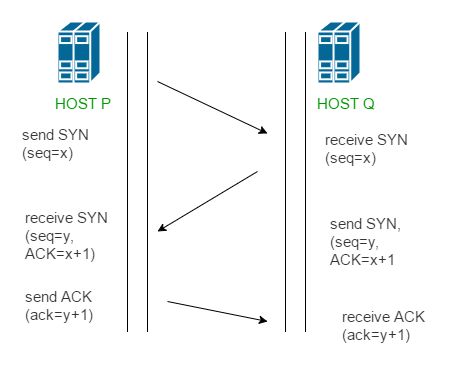
  •  The TCP handshake. TCP uses a three-way handshake to establish a reliable connection. The connection is full duplex, and both sides synchronize (SYN) and acknowledge (ACK) each other. The exchange of these four flags is performed in three steps—SYN, SYN-ACK, and ACK

https://www.sciencedirect.com/topics/computer-science/three-way-handshake


  • The client chooses an initial sequence number, set in the first SYN packet. The server also chooses its own initial sequence number, set in the SYN/ACK packet shown in Figure 3.8. Each side acknowledges each other's sequence number by incrementing it; this is the acknowledgement number. The use of sequence and acknowledgment numbers allows both sides to detect missing or out-of-order segments.

Once a connection is established, ACKs typically follow for each segment. The connection will eventually end with a RST (reset or tear down the connection) or FIN (gracefully end the connection).
https://www.sciencedirect.com/topics/computer-science/three-way-handshake


By default, Wireshark converts all sequence and acknowledgement numbers into relative numbers. This means that all SEQ and ACK numbers always start at 0 for the first packet seen in each conversation


TCP SYN
Since this is the start of the TCP connection, the client sends a TCP packet with the sequence number set to 0. 
the first TCP packet sent from the client to the server includes SYN seq=0 in the Info field.  
see that “Sequence number: 0” and expand the “Flags” field in the details section to also see that the Syn bit is “Set”.


https://madpackets.com/2018/04/10/tcp_handshake/

TCP SYN-ACK
see the server respond with a SYN-ACK message with Seq=0 and Ack=1.
for the TCP handshake example, if the client sends  a seq=0, the server responds with ack=1. The packet is identified as a SYN-ACK packet by looking at the packet listing field and also by looking at the packet details field

TCP ACK
the TCP session sends an acklowledgement to complete the 3-way handshake. (Reminder that the Syn bit is not set). Note that the syn=1 and ack=1, because the TCP-Syn from the server sent a seq=0 and ack=1 in the TCP Syn-Ack 

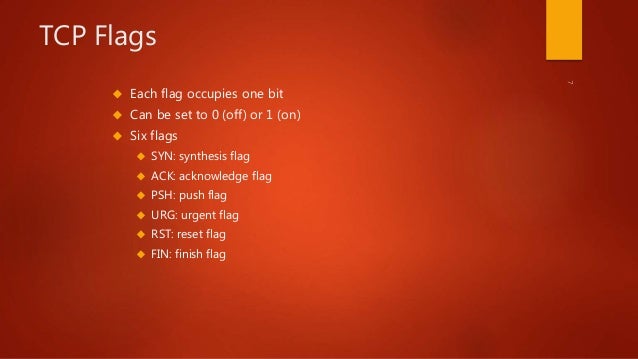
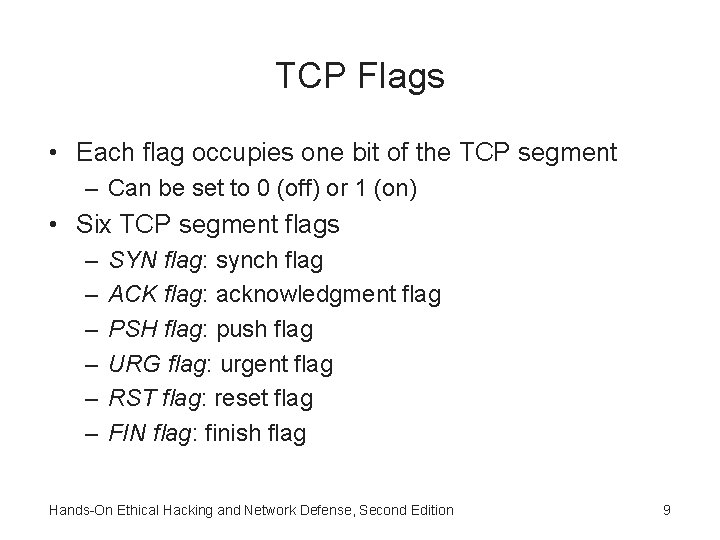
  • The TCP level of the TCP/IP transport protocol is connection-oriented. Connection-oriented means that, before any data can be transmitted, a reliable connection must be obtained and acknowledged. TCP level data transmissions, connection establishment, and connection termination maintain specific control parameters that govern the entire process. The control bits are listed as follows:

URG: Urgent Pointer field significant
ACK: Acknowledgment field significant
PSH: Push Function
RST: Reset the connection
SYN: Synchronize sequence numbers
FIN: No more data from sender

There are two scenarios where a three-way handshake will take place:

Establishing a connection (an active open)

Ending a connection (an active close)

Frame 1:
It's a request to the server to synchronize the sequence numbers. It specifies its initial sequence number (ISN). The ISN is incremented by 1 (8221821+1=8221822), and is sent to the server. To start a connection, the client and server must synchronize each other's sequence numbers.
The Acknowledgment field (ack: 0) is set to zero because it's the first part of the three-way handshake.

Frame 2:
the server, BDC3, sends an ACK and SYN segment (TCP .A..S.)
In this segment, the server is acknowledging the request of the client for synchronization.
Meanwhile, the server is also sending its request to the client for synchronization of its sequence numbers. 
The server transmits an acknowledgment number (8221823) to the client. 
The acknowledgment is just proof to the client that the ACK is specific to the SYN the client initiated. 
The process of acknowledging the client's request allows the server to increment the client's sequence number by one and uses it as its acknowledgment number

Frame 3:
the client sends an ACK segment (TCP .A....)
 In this segment, the client is acknowledging the request from the server for synchronization. The client uses the same algorithm the server implemented in providing an acknowledgment number. The client's acknowledgment of the server's request for synchronization completes the process of establishing a reliable connection and the three-way handshake.

Ending a connection
Although the three-way handshake only requires three packets to be transmitted over our networked media, the termination of this reliable connection needs to transmit four packets. Because a TCP connection is full-duplex (data can flow in each direction independent of the other), each direction must be terminated independently.

Frame 4:
the client sending a FIN that's accompanied by an ACK (TCP .A...F). This segment has two basic functions. First, when the FIN parameter is set, it will inform the server that it has no more data to send. Second, the ACK is essential in identifying the specific connection they've established

Frame 5:
the server acknowledging the FIN that was transmitted from the client.

Frame 6:
After receiving the FIN from the client computer, the server will ACK. Even though TCP has established connections between the two computers, the connections are still independent of one another. So the server must also transmit a FIN (TCP .A...F) to the client.

Frame 7:

The client responds in the same format as the server, by ACKing the server's FIN and incrementing the sequence number by 1.
https://docs.microsoft.com/en-us/troubleshoot/windows-server/networking/three-way-handshake-via-tcpip

  • SYN: The active open is performed by the client sending a SYN to the server. The client sets the segment's sequence number to a random value A.
SYN-ACK: In response, the server replies with a SYN-ACK. The acknowledgment number is set to one more than the received sequence number i.e. A+1, and the sequence number that the server chooses for the packet is another random number, B.
ACK: Finally, the client sends an ACK back to the server. The sequence number is set to the received acknowledgement value i.e. A+1, and the acknowledgement number is set to one more than the received sequence number i.e. B+1.
At this point, both the client and server have received an acknowledgment of the connection. The steps 1, 2 establish the connection parameter (sequence number) for one direction and it is acknowledged. The steps 2, 3 establish the connection parameter (sequence number) for the other direction and it is acknowledged. With these, a full-duplex communication is established.
https://ddos-guard.net/en/terminology/protocols/tcp-3-way-handshake
3 Way Handshaking by Wireshark


What Is a Three-Way Handshake in TCP?


Friday, March 10, 2017

network forensics

  • The Bro Network Security Monitor
Bro is a powerful network analysis framework that is much different from the typical IDS you may know
https://www.bro.org


  • GRR Rapid Response: remote live forensics for incident response
An incident response framework developed by security researchers at Google, the GRR framework analyzes specific workstations for malware footprints. Once both the server side and the agent have been deployed, they become GRR clients and can begin to receive messages from the front end servers, which makes it easy to investigate individual systems. Then the incident response team can perform various forensic tasks on the client machine, such as analyzing the memory, searching various settings and managing configuration options.
https://github.com/google/grr


  • Suricata

Suricata is a free and open source, mature, fast and robust network threat detection engine.
https://suricata-ids.org

  • NetScanTools® Pro
http://www.netscantools.com/nstpromain.html