Showing posts with label hr. Show all posts

Thursday, May 26, 2022

analysis paralysis

  •  What is analysis paralysis?

Analysis paralysis is an affliction people get when they overthink a problem or situation and can't make a decision

The affliction can affect individuals or groups of people as they encounter multiple options or solutions and need to choose the best one


If your options seem equally helpful to you, it can be a challenge to decide which option is best. For example, if one option increases a business's profit, but the other increases its customer outreach, it might be difficult to know which one is better. If your research parameters are too broad, narrowing your options down can also be a challenge. For example, it's more difficult to find an answer to the question, "Where should I run my advertisements?" versus "Where should I run my advertisements that will generate the most customer interest?"


8 tips for combating analysis paralysis


1. Recognize it

One way to recognize it is by comparing it to your other decision-making processes

Examine the last decision you made when someone gave you multiple options. Remember the steps you took to decide and how long the process took. 

If the current decision you need to make is taking a long time and if the steps you used previously aren't working, you might be overthinking the situation.

Once you recognize that you're overthinking it, try to determine why.

if you realize you're overthinking a decision because you're worried about the outcome affecting you negatively, then try to focus on the positive outcomes.


2. Prioritize the decisions

If you have to make a lot of decisions in one day, you might tire yourself and increase your chance of overthinking certain situations

For instance, if you notice you get more tired in the afternoon, try to schedule the tougher decisions for the morning


3. Take a break

When you give yourself a break, it's important to try to not think about the problem or situation. 


4. Ask someone for advice

For example, if you're trying to decide which car you should purchase, consider talking with a friend or family member who recently purchased a car or who has experience with 


5. Make quick decisions

This can help you feel confident in making decisions without overthinking them.


6. Set a deadline

When you set a deadline for a project or solution, it can help force you to make a decision. 


7. Understand your goals

For example, let's say a company is trying to decide on two options: One that will increase their revenue short term and one that will increase their customer outreach long term.

 If it's hoping to grow and develop the business, it might be better to increase its customer outreach. However, if its goal is to generate money more quickly to use it for research and development, it might be better to increase the company's revenue.


8. Limit your information intake

Sometimes, too much information can actually affect how much you overthink a situation or problem.

 It's important to know if any option comes with risks, but once you have the basic knowledge you need, try to make the decision right away.


https://www.indeed.com/career-advice/career-development/analysis-paralysis

  • Analysis paralysis (or paralysis by analysis) describes an individual or group process when overanalyzing or overthinking a situation can cause forward motion or decision-making to become "paralyzed", meaning that no solution or course of action is decided upon within a natural time frame. A situation may be deemed too complicated and a decision is never made, or made much too late, due to anxiety that a potentially larger problem may arise. A person may desire a perfect solution, but may fear making a decision that could result in error, while on the way to a better solution. Equally, a person may hold that a superior solution is a short step away, and stall in its endless pursuit, with no concept of diminishing returns. On the opposite end of the time spectrum is the phrase extinct by instinct, which is making a fatal decision based on hasty judgment or a gut reaction.


In software development, analysis paralysis typically manifests itself through the waterfall model with exceedingly long phases of project planning, requirements gathering, program design, and data modeling, which can create little or no extra value by those steps and risk many revisions

Analysis paralysis can occur when there is a lack of experience on the part of workers such as systems analysts, project managers or software developers, and could be due to a rigid and formal organizational culture.

Analysis paralysis can also arise from extensive experience or expertise, which serves to increase the number of options and considerations that appear at every decision point.

Agile software development methodologies explicitly seek to prevent analysis paralysis, by promoting an iterative work cycle that emphasizes working products over product specifications, but requires buy-in from the full project team. In some instances, Agile software development ends up creating additional confusion in the project in the case where iterative plans are made with no intention on having the team following through.

https://en.wikipedia.org/wiki/Analysis_paralysis

Friday, June 14, 2019

80/20 Principle


  • Applying 80/20 Principle in Our Life

The 80/20 rule tells us that a large proportion of effects is due to a small portion of causes.

20% of causes lead to 80% of results. These are what I call the 20% high-value tasks. High-value because they lead to high-impact results.
On the other hand, 80% of causes lead to 20% of results. These are what I call the 80% low-value tasks.
It doesn’t have to be a literal 80-20 ratio — for example, 70% of the effects can be contributed by 15% of the causes, or 60% of effects can be contributed by 30% of the causes. The percentages of effects and causes don’t have to add up to 100% either — 80% refers to the effect while 20% refers to the cause, meaning they are not of the same denominato

The point of the 80/20 rule is to know that (a) the relationship between cause and effect is often not 1:1, and (b) some causes have more weight than others.

Fact #1: Understanding that Less is More
Firstly, not everything is equal. No matter what you do, there are always a few vital tasks that matter. You want to focus on the vital few, the 20% high-value tasks, rather than spread yourself thin across everything. This is also known as “Less is More” where doing less will net you more results
Applying “Less is More” means asking yourself:

How can I remove the tasks that do not create as much value?
How can I focus my energy on activities that make me happier and more fulfilled?

Fact #2: Achieving More with Less

What if we don’t achieve “More with More”? What if we really achieve “More with Less”? Where we make more progress by focusing on the vital few? By channeling all our energy to the things that matter — not by trying to chase every shiny thing?
The 80/20 rule is about how to get more out of your life.
https://personalexcellence.co/blog/80-20/

  • The Pareto principle (also known as the 80/20 rule) is a phenomenon that states that roughly 80% of outcomes come from 20% of causes
In other words, a small percentage of causes have an outsized effect

But what techniques do you use to identify what needs to get done first?
One common technique is called the Pareto principle, also known as the 80/20 rule.This technique can help you determine and prioritize your highest-impact tasks, increasing your productivity throughout the day.
This concept is important to understand because it can help you identify which initiatives to prioritize so you can make the most impact

The 80/20 rule is not a formal mathematical equation, but more a generalized phenomenon that can be observed in economics, business, time management, and even sports.

How to use the 80/20 rule
the Pareto principle is commonly used in business and economics. This is because the 80/20 rule is helpful in determining where you can focus your efforts to maximize your output. 
If you have any kind of work that can be segmented into smaller portions, the Pareto principle can help you identify what part of that work is the most influential.

Productivity

You can use the 80/20 rule to prioritize the tasks that you need to get done during the day. 
The idea is that out of your entire task list, completing 20% of those tasks will result in 80% of the impact you can create for that day.
To do this, list out all of the things that you need to get done that day. 
Then identify which of those tasks have the highest impact
Are there any tasks on your plate that are blocking projects from moving forward? These tasks may be simple in execution, but they can make a large impact to the rest of the team by allowing the process to keep flowing. 

Decision making

The Pareto principle can help you to make the best decisions during the problem-solving process. 
When there are many different causes to one problem, the Pareto principle can help you prioritize solutions

Identify the problems that your team is experiencing.
Identify the causes of these problems.
Categorize your problems into similar groups
Assign a value to each of these problems based on the impact to the business.

Develop a plan to focus on the top 20% of the problems that impact the business
The idea is that one solution can resolve multiple problems. Based on the values you assigned to each problem, calculate which ones are in the top 20%.
Once you’ve identified the main problem, develop a plan to create a solution that can result in 80% of the results

Quality control

The Pareto analysis and the Pareto chart are key tools used within the Six Sigma quality control methodology.
In the Six Sigma methodology, using a Pareto chart can help you visualize your data to identify how to prioritize actions. Six Sigma’s main goal is to reduce the amount of variation in a process with the goal of increasing the amount of production. Pareto charts are common in Six Sigma methodology because you can quickly identify what the majority of the variations are in a process.

Other benefits of using the Pareto principle:

    Clear priorities both for you and your team

    Increased daily productivity

    Ability to portion your work into manageable segments

    More focused strategy

Disadvantages of using the 80/20 rule

​​There's a common misinterpretation of the Pareto principle that with 20% of effort, you can achieve 80% of the results
The 20 and 80% numbers don’t refer to the amount of effort you’re putting in, but the causes and consequences you’re working on.
The goal is not to minimize the amount of effort, but to focus your effort on a specific portion of work to create a bigger impact
You still have to put 100% of effort into that 20% of focus to achieve 80% of results

Another downside of the 80/20 rule is that sometimes team members can get too focused and lose sight on other tasks

If you only focus on the important tasks and put aside the less important tasks, like email and other correspondence, things can get lost. The challenge is finding the right balance of using the 80/20 rule, and getting through the rest of your tasks—even if they don't result in 80% of results
https://asana.com/resources/pareto-principle-80-20-rule

Analysis Paralysis


  • How to Stop Analysis Paralysis: 8 Important Tips

Analysis paralysis is the state of over-thinking about a decision to the point that a choice never gets made. You face analysis paralysis when you…

    are overwhelmed by the available options,
    over-complicate the decision when it’s supposed to be quite a simple one,
    feel compelled to pick the “best” and “perfect” choice, there
    by delaying any decision until you do your research, or
    feel a deep fear of making a wrong move, hence stalling yourself from making any decision, in case you make the wrong choice.

8 Tips to Overcome Analysis Paralysis

1) Differentiate between big and small decisions
3 questions to differentiate between big and small decisions:
    How important is this decision?
    Will this impact me a year from now?
        What’s the worst thing that could happen?
2) Identify your objective
Last week I had a coaching call with a client who asked me for advice between two job options. The first is to remain in his current job — a well-paying job, living where he is now, in a stable work environment and country. The other is a job overseas — a bustling city, a dynamic job with great responsibilities, in an environment he has never been in before.

Both jobs have their pros and cons. The former offers security and great financial rewards with a manageable job scope. The latter offers immense personal growth with some degree of uncertainty and pressure, because everything is new to him.

So I asked my client, “What is your vision for your life for the next few years?”

He said that he’s sick of the predictability in his routine. He feels that everything is the same in his current job and he’s not learning much. He feels that his goal for the coming period is to grow, learn about different things, and see other things in life. As he is in his early 30s, now is the best time to explore the world
3) Perfection is not the key. “Moderately okay” is.
Unless you are dealing with a life-altering decision like who to marry and what career path to choose, perfection is not the key. Your goal is to pick a moderately “okay” choice in a fair amount of time, and then move on.
4) Eliminate the bad options
5) Let go of your childhood stories

6) Set a time limit
Do you know the Parkinson’s Law? The Parkinson’s Law says, “Work expands so as to fill the time available for its completion.” What this means is that your work will take however long you allow it to take. If you set aside 15 minutes for a task, it’ll take 15 minutes. If you set aside 30 minutes, it’ll take 30 minutes. If you don’t set a time limit, it may take forever
7) Get a trusted opinion
8) Channel your energy into bigger goals
https://personalexcellence.co/blog/analysis-paralysis/


  • Paralysis by analysis is the state of over-analyzing (or over-thinking) a situation so that a decision or action is never taken, in effect paralyzing the outcome. This state of over-thinking about a decision leads the individual to the point where a choice never gets made, thereby creating a paralyzed state of inaction

Tip #1. Differentiate between big and small decisions.
Tip #2. Identify your objective(s).
Tip #3. Perfection is not the key.
Tip #4. Eliminate the bad options.
Tip #5. Pick one and go
Tip #6. Let go of your history surrounding decision making
Tip #7. Set a hard time limit.
Tip #8. Delegate the decision to someone else.
Tip #9. Get the opinion of someone you trust and go with it.
https://bsci21.org/9-tips-to-avoid-paralysis-by-analysis/

Thursday, May 23, 2019

Storytelling


  • Storytelling Is an Essential Skill for Inspirational Leaders and Companies


What Is Storytelling?
Storytelling is the ability to understand and communicate the story of your organization. It’s an extremely important skill for every leader, manager and employee to learn.
In addition, storytelling is not about controlling the narrative, being deceitful or listening to yourself talk. It’s about speaking to a group of people and being authentic in the way you communicate.
When you tell a story, you connect your message to your organization’s mission, your department’s goals and your customers. You can also connect your message to your own life and deliver it in a positive, motivational manner.

Developing Your Storytelling Skills
So how do you become a good storyteller? The key is practice, self-reflection and authenticity.
Practice is easy. Just lead meetings and communicate the mission, vision, purpose and objectives of your organization again and again.
Self-reflection is more difficult. After every meeting, reflect on how well you did and make corrections without being too hard on yourself. It also helps to have a trusted peer who can give you honest feedback on your performance.
https://onlinecareertips.com/2018/03/storytelling-essential-skill-leaders/

Soft Skills

Soft Skills: What They Are & How You Can Develop Them
These are skills that are difficult to teach and hiring managers use them to separate candidates evenly-matched in other areas.

What Are Soft Skills?
They include personality traits, social skills, communication ability, and personal attributes that improve your chances of being a success in any workplace. While ‘hard’ skills are technical in nature and can be taught, it is extremely difficult to ‘learn’ soft skills; the best you can hope for is to improve what you already have.

You need soft skills when dealing with colleagues and customers. When you have a team full of individuals with a high level of soft skills, it is likely to function extremely well.

How to Develop Soft Skills
It is true that soft skills take time to acquire, but you can improve and develop yours with experience and effort.
Communication: Work on your public speaking skills.
Teamworking: Rather than ignoring colleagues that need help, step in and offer to lend a hand
Problem Solving: As often as if possible, think about an issue affecting an existing project and only speak to your manager when you believe you have a solution.
Leadership: It isn’t easy taking charge of a group of people.

Examples of Soft Skills that Employers Look For:

Communication
Employers want staff who know how to listen and absorb information, ask intelligent questions and have the ability to speak politely and clearly on any subject

Critical Thinking
critical thinking isn’t really about ‘criticising.’ Instead, it involves analysing situations without bias and finding the pros and cons.
Related skills include creativity, being adaptable, showing innovation, problem-solving, and analytical skills.

Leadership
Related leadership skills include decision making, conflict resolution, motivating, and supervising.

Teamworking
If there is a tough situation in the workplace, you are required to have the innovation, calmness, and resolve to deal with it. Related leadership skills include decision making, conflict resolution, motivating, and supervising.

Working Under Pressure
Related skills include time management and work ethic.


https://www.jobs.ie/job-talk/soft-skills/?cid=Newsletter_B2C_81887&cid=MAILING_81887_190523_A07715FB57E34B5A989660B72E6AF00B_COL_LEFT&utm_source=mailing&utm_medium=email&utm_campaign=81887

Saturday, April 20, 2019

The situation, task, action, result (STAR)

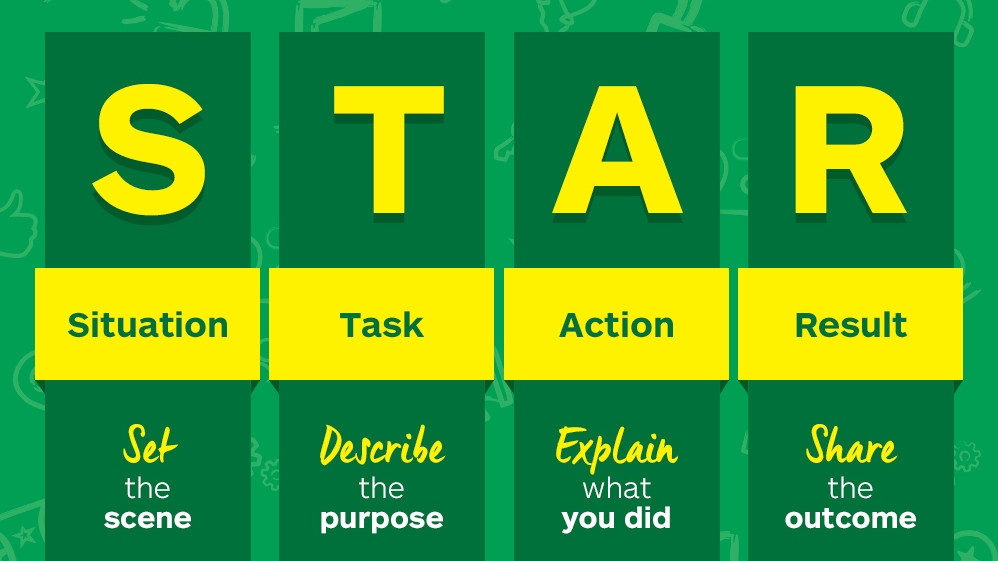
  • The situation, task, action, result (STAR) format is a technique used by interviewers to gather all the relevant information about a specific capability that the job requires

Situation: The interviewer wants you to present a recent challenge and situation in which you found yourself.
Task: What were you required to achieve? The interviewer will be looking to see what you were trying to achieve from the situation
Action: What did you do? The interviewer will be looking for information on what you did, why you did it and what the alternatives were.
Results: What was the outcome of your actions? What did you achieve through your actions and did you meet your objectives? What did you learn from this experience and have you used this learning since?
https://en.wikipedia.org/wiki/Situation,_task,_action,_result

  • STAR stands for Situation, Task, Action, Result. Using this strategy is particularly helpful in response to competency-focused questions, which typically start out with phrases such as, "Describe a time when..." and "Share an example of a situation where...."

The STAR interview response technique is a way of answering behavioral interview questions.
Behavioral interview questions are questions about how you have behaved in the past.
Specifically, they are about how you have handled certain work situations.
For example, employers might be looking for proof of problem-solving skills, analytical ability, creativity, perseverance through failure, writing skills, presentation skills, teamwork orientation, persuasive skills, quantitative skills, or accuracy.
Examples of behavioral interview questions include the following:
Tell me about an occasion when you had to complete a task under a tight deadline.
Have you ever gone above and beyond the call of duty?
What do you do when a team member refuses to complete his or her quota of the work?
However, job seekers can also use the STAR interview method to prepare for behavioral interview questions.
STAR is an acronym for four key concepts. Each concept is a step the job candidate can utilize to answer a behavioral interview question.
Situation: Describe the context within which you performed a job or faced a challenge at work. For example, perhaps you were working on a group project, or you had a conflict with a coworker. This situation can be drawn from a work experience, a volunteer position, or any other relevant event.
Task: Next, describe your responsibility in that situation.
Perhaps you had to help your group complete a project within a tight deadline, resolve a conflict with a coworker, or hit a sales target.
Action: You then describe how you completed the task or endeavored to meet the challenge. Focus on what you did, rather than what your team, boss, or coworker did. (Tip: Instead of saying, "We did xyx," say "I did xyz.")
Result: Finally, explain the outcomes or results generated by the action taken. It may be helpful to emphasize what you accomplished, or what you learned.

How to Prepare for an Interview Using STAR
Since you won’t know in advance what interviewing techniques your interviewer will be using, you’ll benefit from preparing several scenarios from the jobs you’ve held.
First, make a list of the skills and/or experiences that are required for the job.
It may help you to look at the job listing and similar job listings for indications of the required or preferred skills/qualities and match your qualifications to those listed in the posting.
Then, consider specific examples of occasions when you displayed those skills.
For each example, name the situation, task, action, and result.

Examples of Interview Questions and Answers Using STAR
Example Question 1: Tell me about a time you had to complete a task within a tight deadline. Describe the situation, and explain how you handled it.
Example Question 2: What do you do when a team member refuses to complete his or her quota of the work?
Example Question 3: Tell me about a time you showed initiative on the job.

https://www.thebalancecareers.com/what-is-the-star-interview-response-technique-2061629


  • What is a Behavioral Job Interview?

Behavioral based interviewing is interviewing based on discovering how the interviewee acted in specific employment-related situations
The logic is that how you behaved in the past will predict how you will behave in the future, i.e., past performance predicts future performance.
Traditional Interviews
In a traditional interview, you will be asked a series of questions which typically have straightforward answers like "What are your strengths and weaknesses?" or "What major challenges and problems did you face? How did you handle them?" or "Describe a typical work week."
In a behavioral interview, an employer has decided what skills are needed in the person they hire and will ask questions to find out if the candidate has those skills.
Instead of asking how you would behave, they will ask how you did behave.
The interviewer will want to know how you handled a situation, instead of what you might do in the future.

Questions Asked
Behavioral interview questions will be more pointed, more probing and more specific than traditional interview questions:
Finally, review the job description, if you have it, or the job posting or ad. You may be able to get a sense of what skills and behavioral characteristics the employer are seeking from reading the job description and position requirements.
It's important to keep in mind that there are no right or wrong answers. The interviewer is simply trying to understand how you behaved in a given situation. How you respond will determine if there is a fit between your skills and the position the company is seeking to fill.
https://www.thebalancecareers.com/behavioral-job-interviews-2058575

  • The interviewer will want examples of what happened in a particularly challenging circumstance, what you did, and how you achieved a positive outcome.

The Best Behavioral Interviewing Techniques and Strategies
Review what a behavioral interview is and what companies are looking for during a behavioral interview.
Use the STAR interview technique to prepare examples to share during an interview.
Review sample behavioral interview questions.

Research the Job and Company
Techniques
(S) A specific situation
(T) The tasks that needed to be done
(A) The action you took
(R) The results, i.e., what happened


It is the STAR interview response technique, and it's an excellent way to prepare. Do keep in mind that there are no right or wrong answers to behavioral interview questions. The interviewer's goal is to understand how you behaved in a given situation. How you respond will determine if there is a match between your skills and the position the company is seeking to fill.

https://www.thebalancecareers.com/behavioral-interview-techniques-and-strategies-2059621


  • Behavioral Based Job Interview Questions

In a behavioral job interview, the company asks questions about your past work experiences in order to find out if you have the skills needed for the job. Behavioral interview questions focus on how you handled various work situations in the past. Your response will reveal your skills, abilities, and personality.

(S) Situation. Describe the situation in which the event took place.
(T) Task. Describe the task you were asked to complete. If there was a particular problem or issue you were trying to solve, describe that here.
(A) Action. Explain what action you took to complete the task or solve the problem.
(R) Results. Explain the result of your actions. For example, if your actions resulted in completing a task, resolving a conflict, improving your company’s sales record, etc., explain this. Try to focus on how your actions resulted in a success for the company.

Follow the STAR Technique. Be sure to answer any questions using the STAR technique described above. By completing each of the four steps, you will provide a thorough answer without rambling or getting off topic.
Be Positive. Often, behavioral interview questions require you to focus on a problem or a failure at work. Describe the problem or issue you faced, but don’t focus too much on the negative. Quickly shift to describing how you solved the problem and the positive results.

Give an example of a goal you didn't meet and how you handled it.
Have you been in a situation where you didn't have enough work to do?
Have you ever made a mistake? How did you handle it?
Have you ever dealt with company policy you weren't in agreement with? How?
When you worked on multiple projects how did you prioritize?

https://www.thebalancecareers.com/behavioral-job-interview-questions-2059620


  • Competency-Based Interview Questions

Competency-based interview questions require interviewees to give specific examples of times in which they demonstrated particular skills or attitudes.
Often, these types of questions begin with the phrases "Describe a time when..." or "Give me an example of a situation where..."
Generally, these questions require interviewees to describe a problem or situation, the actions they took to handle it, and the end results.
They allow the employer to quickly evaluate a candidate's mindset, and gauge how a candidate handles certain situations.
an interviewer for an upper management job may ask questions about leadership, independence, and creativity.

How to Prepare for Competency-Based Interview Questions
make a list of skills and attitudes that you think are important for the job for which you are interviewing.
Check the job listing for examples of required abilities.
Next, list situations in which you have demonstrated each of these competencies.
For each situation, write down the situation or problem, the actions you took to handle the problem, and the ultimate results
STAR stands for situation, task, action, result. Using this technique will help you give a brief, coherent, and structured response to interview questions.
Once you have prepared a list of situations, review it. By thinking of examples before the interview, you will be able to answer questions quickly and concisely.

Be Concise
It is easy to wander when answering a competency-based interview question, particularly if you do not have a specific situation or problem in mind.
Do Not Place Blame
If you are describing a particular problem or difficult situation (for example, a time when you had to work with a difficult boss), it may feel natural to attack or place blame on another person. However, these questions are about you, not about anyone else. Focus on what you did to manage the situation; do not dwell on other peoples’ issues or failures.


Examples of Competency-Based Interview Questions
Adaptability
Tell us about the biggest change you have had to deal with in your previous employment. How did you handle it?
Decisiveness
Tell us about a decision you made that you knew would be unpopular with certain people. How did you handle the decision-making process? How did you handle other peoples’ negative reactions?
Integrity
Tell us about a time when someone asked you to do something you objected to. How did you handle the situation?
Resilience
How do you deal with stress?
Describe a time in which you received negative feedback from an employer, colleague, or client. How did you manage this feedback? What was the outcome?
https://www.thebalancecareers.com/competency-based-interview-questions-2061195


  • This method is slightly more involved than the STAR method and some people may prefer using it, particularly if they have a lot of management experience from which to draw examples.

The SOARA method:

1) Identify a Situation that enables you to illustrate how you behaved in that recent event, giving particular emphasis to describing the required competency the question is aimed at assessing.

2) State the Objective you wanted to attain by the conclusion of this situation or event.

3) Describe what Action you took to achieve your objective. Your actions and behaviors must reflect those of someone who is performing the role. This is most easily shown in your reasoning for doing what you did and how you assessed alternatives.

4) Make sure you clearly state the Results of your decisions and actions as well as how you attained your objective.

5) Conclude your answer with a summary of what you learnt from this situation and how this has influenced you since. This is referred to as the Aftermath

To make it easier to identify the best events and challenges Helena has quickly created a 'situation mind map' from her work experiences and personal achievements. This visual representation of her resume will be copied and completed for each competency required in the role. In this example it is for 'strategic thinking.'

This mind map shows the five projects that enable her to illustrate strategic thinking. The table below shows how she uses SOARA to prepare an answer to the selected question.
If you are going to succeed in a competency-based interview then your answers must:

• Be specific in their description and detail
• Be concise and highlight your achievements clearly
• Show your actions were structured
• Convey the maximum achievement in the minimum time
• Give a strong and positive impression at the end of your answer
• Show what you learnt from the situation.

Key Points
The SOARA method is slightly more involved than the STAR method.
SOARA stands for: Situation, Objective, Action, Results, and Aftermath.
The process is similar to that of the STAR method explained earlier in that it is time consuming and takes a lot of work.
Both methods provide you with the best examples of competency-specific behaviors that you can use in all of your interviews.

http://www.free-management-ebooks.com/faqcr/competency-04.htm

Thursday, April 4, 2019

subject matter expert


  • subject matter experts have developed their expertise in their particular discipline over a long period of time and after a great deal of immersion in the topic.

Many subject matter experts have pursued advanced degrees in their area of specialization.Additionally, the experts maintain a rigorous program of continuous study in their field. Many are active as authors, publishing books or articles on their topic. Others serve as educators in college and universities.
"Mary is our expert on that particular operating system. She can help us assess whether this new application is compatible with others."
"Juan is our data management specialist. He helps us understand how to extract and format the data for our marketing project."
"Dave is the Chief Software Architect for our software company. He understands our customer needs and how our software products must be designed to meet those needs better than anyone in our firm."
https://www.thebalancecareers.com/subject-matter-expert-2275099

Tuesday, March 5, 2019

If You’re Not Interviewing Anywhere Else


  • If You’re Not Interviewing Anywhere Else

You know not to say this directly, but how do you get around it? The trick is to simply choose to answer a different question. Instead of responding with your lack of other interviews, let your interviewer know what types of positions and companies you’ve been applying to.
https://www.themuse.com/advice/how-to-answer-what-other-companies-are-you-interviewing-with


  • Let’s start by considering why hiring managers ask this question in the first place. There are three big-picture reasons.

To gauge their own timeline.
Your hiring manager may want to know where in the hiring process you are with other companies so that they can speed up the decision-making process on their end if necessary. They also may not want to invest much more time into your candidacy if they sense that you are close to accepting an offer elsewhere (particularly if they were not all that keen on you to begin with).
To assess the supply and demand in the market.
The hiring manager may be asking this tough interview question to try to get a sense for how many similar positions are open right now. That can impact the economics of the offer – in your favor, or in favor of the company.
To get a sense for your popularity.
Sometimes, hiring managers like to get external confirmation that you are a valuable and in-demand candidate. This may not make logical sense–after all, if they are interviewing you, there must be something about your background they like! And yet, sometimes they want to hear it from other companies.
https://www.topresume.com/career-advice/how-to-answer-where-else-are-you-interviewing


  • To demonstrate your commitment and still make it clear that you’re a valuable candidate who is already on the radar of other employers, be enthusiastic while showing that you do have other opportunities.

https://www.wayup.com/guide/answer-companies-interviewing/


  • “I’m actively interviewing and I’m talking with a number of early stage technology companies like yours

If they press you for specific company names:
Do NOT give them company names.
https://careersidekick.com/what-other-companies-are-you-interviewing-with/

Wednesday, September 12, 2018

responsibility vs task vs duty


  • Difference Between Duties and Responsibilities

Every one has come across the terms duty and responsibility. Duty is a moral commitment to something or someone, whereas responsibility is a condition of being responsible

As duty refers to moral commitment, it denotes an active feeling for doing something. Once a person engages himself with some duty or if he has been entrusted with a duty, then that person fully commits himself to it. In the case of duty, the person will be involved in activity without any self-interest. As a citizen of a country, a person has many duties to perform. It is his duty to adhere to the constitution

Read more: Difference Between Duties and Responsibilities | Difference Between http://www.differencebetween.net/miscellaneous/difference-between-duties-and-responsibilities/#ixzz5QrBxqqn9


  • Responsibility can be termed as an ability to act at one’s own will, without any supervision. It is the obligation to successfully complete an assigned task. In responsibility, a person takes upon the duty to compete the task and to make the task a success.

http://www.differencebetween.net/miscellaneous/difference-between-duties-and-responsibilities/


  • Job responsibilities are what an organization uses to define the work that needs to be performed in a role and the functions that an employee is accountable for. Job responsibilities also include the information most vital to your other talent management processes since it defines the criteria that should be used for employee assessment and development.

The detailed task list is perhaps the easiest approach, and the more traditional way of describing job responsibilities.
https://www.saba.com/resources/how-tos/writing-effective-job-responsibilities-essential-functionscompetencies


  • The distinction hinges on the question, “Why do I do this?” The responsibility is high level, and the task is specific. One responsibility may carry five (or more) associated tasks. If you can eliminate one responsibility through clarification, you may eliminate several tasks. You carry out tasks to fulfill responsibilities.

https://www.whatsbestnext.com/2010/06/the-difference-between-responsibilities-and-tasks/

Tuesday, September 11, 2018

sre vs devops

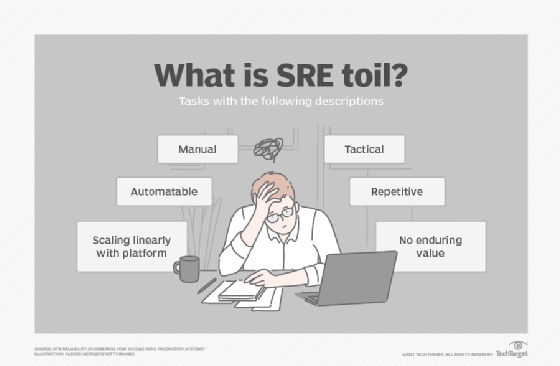
  • For the purposes of this chapter, we’ll define toil as the repetitive, predictable, constant stream of tasks related to maintaining a service.

System maintenance inevitably demands a certain amount of rollouts, upgrades, restarts, alert triaging, and so forth. These activities can quickly consume a team if left unchecked and unaccounted for. Google limits the time SRE teams spend on operational work (including both toil- and non-toil-intensive work) at 50% 

What Is Toil?

Here, we provide a concrete example for each toil characteristic:


Manual

    When the tmp directory on a web server reaches 95% utilization, engineer Anne logs in to the server and scours the filesystem for extraneous log files to delete.

Repetitive

    A full tmp directory is unlikely to be a one-time event, so the task of fixing it is repetitive.


Automatable

    If your team has remediation documents with content like “log in to X, execute this command, check the output, restart Y if you see…,” these instructions are essentially pseudocode to someone with software development skills! In the tmp directory example, the solution has been partially automated. It would be even better to fully automate the problem detection and remediation by not requiring a human to run the script. Better still, submit a patch so that the software no longer breaks in this way.


Nontactical/reactive

    When you receive too many alerts along the lines of “disk full” and “server down,” they distract engineers from higher-value engineering and potentially mask other, higher-severity alerts. As a result, the health of the service suffers.


Lacks enduring value

    Completing a task often brings a satisfying sense of accomplishment, but this repetitive satisfaction isn’t a positive in the long run. For example, closing that alert-generated ticket ensured that the user queries continued to flow and HTTP requests continued to serve with status codes < 400, which is good. However, resolving the ticket today won’t prevent the issue in the future, so the payback has a short duration.


Grows at least as fast as its source

    Many classes of operational work grow as fast as (or faster than) the size of the underlying infrastructure. For example, you can expect time spent performing hardware repairs to increase in lock-step fashion with the size of a server fleet. Physical repair work may unavoidably scale with the number of machines, but ancillary tasks (for example, making software/configuration changes) doesn’t necessarily have to.


Case Study 1: Reducing Toil in the Datacenter with Automation
Case Study 2: Decommissioning Filer-Backed Home Directories

Conclusion

At minimum, the amount of toil associated with running a production service grows linearly with its complexity and scale. 
Automation is often the gold standard of toil elimination, and can be combined with a number of other tactics. Even when toil isn’t worth the effort of full automation, you can decrease engineering and operations workloads through strategies like partial automation or changing business processes.

https://sre.google/workbook/eliminating-toil/


  • Prior to Google’s creation of the SRE position, System Administrators ran company operations.

System Administrators worked on the “operations” side of things, whereas engineers worked on the “development” side of things.

Now let’s say that one of the servers in the data center went down and needed to be replaced. With the “old way,” a new server would be configured manually by a system administrator. What this means is that the sysadmin would manually make sure the new machine has the proper operating system, software, tags, etc. Now imagine that 1,000 servers need to be replaced. See where I am going with this? It would take forever, or the company would need a lot of sysadmins to do the labo

“You will automate the server provisioning process to reduce the labor of our networking engineering and datacenter operations teams. Once we plug a new server in, it walks itself through all aspects of provisioning to join the fleet without any human involvement.”

“SREs are Software Engineers who specialize in reliability. SREs apply the principles of computer science and engineering to the design and development of computer systems: generally, large distributed ones.”

By eliminating human interaction through automation, SREs make systems more reliable

https://hackernoon.com/so-you-want-to-be-an-sre-34e832357a8c


  • Site Reliability Engineering


This systems administrator, or sysadmin, approach involves assembling existing software components and deploying them to work together to produce a service.
Sysadmins are then tasked with running the service and responding to events and updates as they occur.
As the system grows in complexity and traffic volume, generating a corresponding increase in events and updates, the sysadmin team grows to absorb the additional work. Because the sysadmin role requires a markedly different skill set than that required of a product’s developers, developers and sysadmins are divided into discrete teams: "development" and "operations" or "ops."

The sysadmin model of service management has several advantages. For companies deciding how to run and staff a service, this approach is relatively easy to implement: as a familiar industry paradigm, there are many examples from which to learn and emulate.

The sysadmin approach and the accompanying development/ops split has a number of disadvantages and pitfalls. These fall broadly into two categories: direct costs and indirect costs.

Direct costs are neither subtle nor ambiguous. Running a service with a team that relies on manual intervention for both change management and event handling becomes expensive as the service and/or traffic to the service grows, because the size of the team necessarily scales with the load generated by the system.

The indirect costs of the development/ops split can be subtle, but are often more expensive to the organization than the direct costs. These costs arise from the fact that the two teams are quite different in background, skill set, and incentives. They use different vocabulary to describe situations; they carry different assumptions about both risk and possibilities for technical solutions; they have different assumptions about the target level of product stability. The split between the groups can easily become one of not just incentives, but also communication, goals, and eventually, trust and respect

Traditional operations teams and their counterparts in product development thus often end up in conflict, most visibly over how quickly software can be released to production. At their core, the development teams want to launch new features and see them adopted by users. At their core, the ops teams want to make sure the service doesn’t break while they are holding the pager. Because most outages are caused by some kind of change—a new configuration, a new feature launch, or a new type of user traffic—the two teams’ goals are fundamentally in tension.

("We want to launch anything, any time, without hindrance" versus "We won’t want to ever change anything in the system once it works"). And because their vocabulary and risk assumptions differ

The ops team attempts to safeguard the running system against the risk of change by introducing launch and change gates

The dev team quickly learns how to respond. They have fewer "launches" and more "flag flips," "incremental updates," or "cherrypicks." They adopt tactics such as sharding the product so that fewer features are subject to the launch review.

our Site Reliability Engineering teams focus on hiring software engineers to run our products and to create systems to accomplish the work that would otherwise be performed, often manually, by sysadmins.


What exactly is Site Reliability Engineering, as it has come to be defined at Google? My explanation is simple: SRE is what happens when you ask a software engineer to design an operations team

As a whole, SREs can be broken down into two main categories.

50–60% are Google Software Engineers, or more precisely, people who have been hired via the standard procedure for Google Software Engineers. The other 40–50% are candidates who were very close to the Google Software Engineering qualifications (i.e., 85–99% of the skill set required), and who in addition had a set of technical skills that is useful to SRE but is rare for most software engineers. By far, UNIX system internals and networking (Layer 1 to Layer 3) expertise are the two most common types of alternate technical skills we seek.

Therefore, SRE is fundamentally doing work that has historically been done by an operations team, but using engineers with software expertise, and banking on the fact that these engineers are inherently both predisposed to, and have the ability to, design and implement automation with software to replace human labor.


Eventually, a traditional ops-focused group scales linearly with service size: if the products supported by the service succeed, the operational load will grow with traffic. That means hiring more people to do the same tasks over and over again.

we want systems that are automatic, not just automated. In practice, scale and new features keep SREs on their toes.

DevOps or SRE?
 Its core principles—involvement of the IT function in each phase of a system’s design and development, heavy reliance on automation versus human effort, the application of engineering practices and tools to operations tasks—are consistent with many of SRE’s principles and practices

 One could view DevOps as a generalization of several core SRE principles to a wider range of organizations, management structures, and personnel. One could equivalently view SRE as a specific implementation of DevOps with some idiosyncratic extensions.

https://landing.google.com/sre/book.html


  • while R&D focused on creating new features and pushing them to production, the Operations group was trying to keep production as stable as possible—the two teams were pulling in opposite directions.

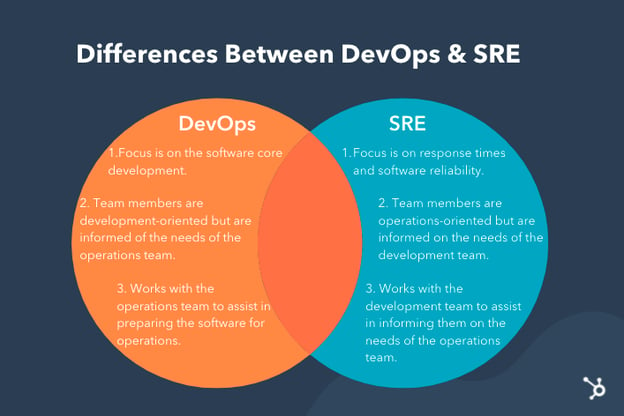
Instead of having an Ops team built solely from system administrators, software engineers—with an R&D background and mentality—could enrich the way the team worked with the development group, change its goals and help with automating solutions.

According to Google, SRE engineers are responsible for the stability of the production environment, but at the same time are committed to new features and operational improvement.
Google decided its SRE teams should be composed of 50 percent software engineers and 50 percent system administrators.

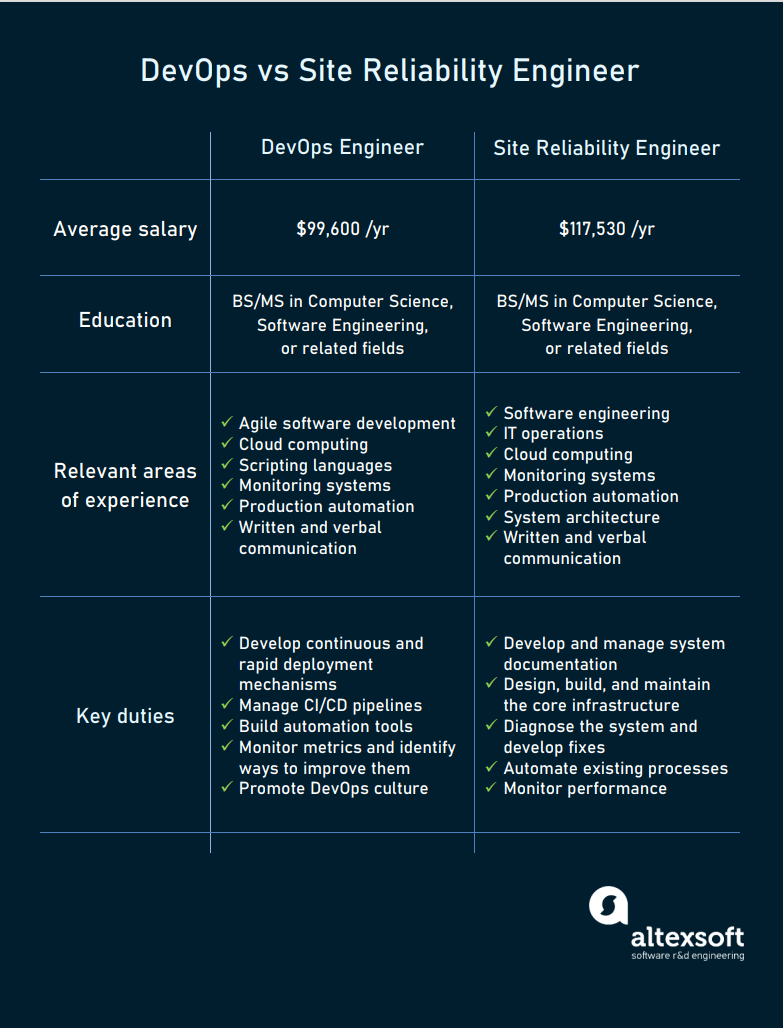
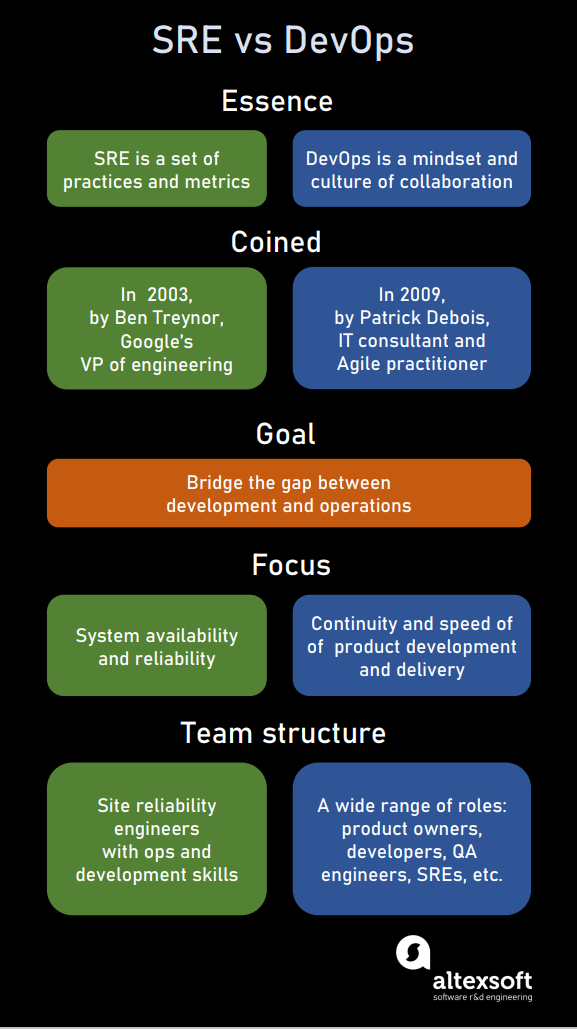
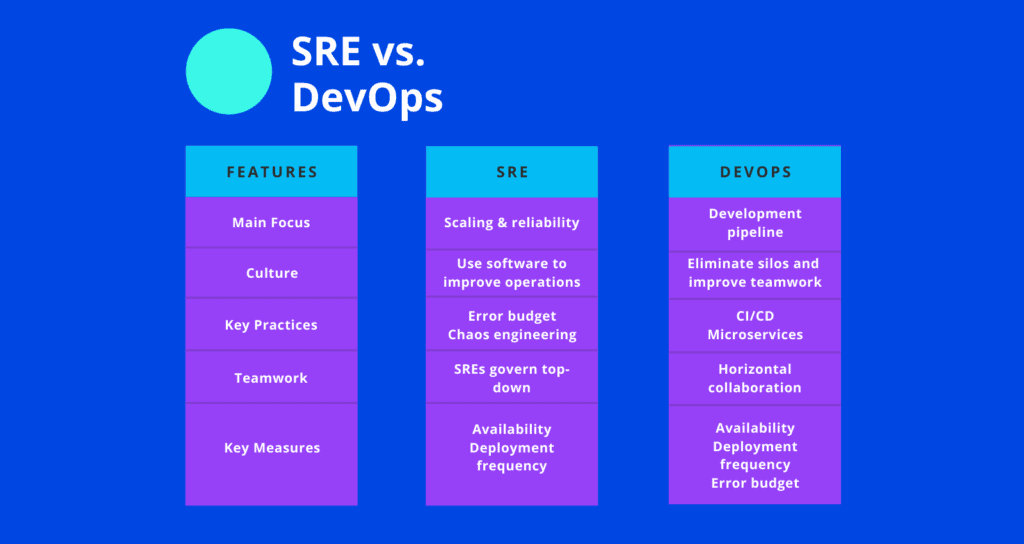
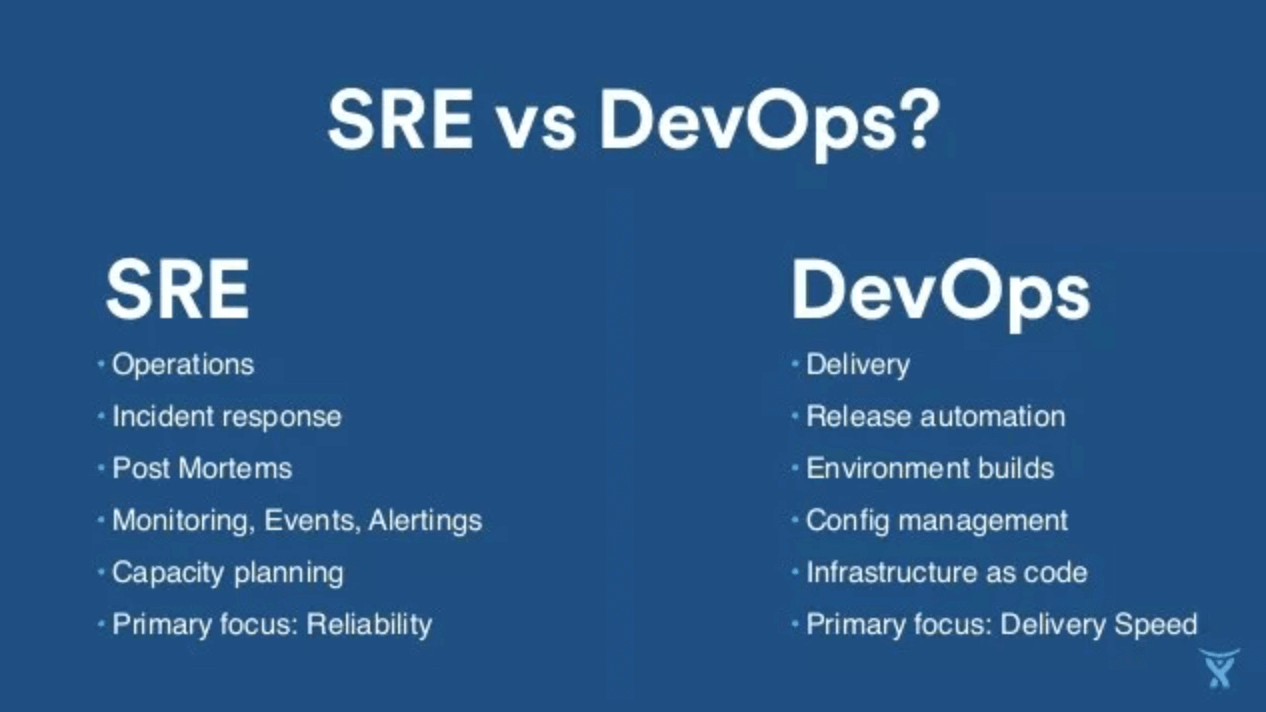
Both SRE and DevOps are methodologies addressing organizations’ needs for production operation management
While DevOps raise problems and dispatch them to Dev to solve, the SRE approach is to find problems and solve some of them themselves.
While DevOps teams would usually choose the more conservative approach, leaving the production environment untouched unless absolutely necessary,

For each service, the SRE team sets a service-level agreement (SLA) that defines how reliable the system needs to be to end users.

For each service, the SRE team sets a service-level agreement (SLA) that defines how reliable the system needs to be to end users. If the team agrees on a 99.9 percent SLA, that gives them an error budget of 0.1 percent. An error budget is exactly what the name suggests: the maximum allowable threshold for errors and outages. Here’s the interesting thing: the development team can “spend” this error budget in any way they like. If the product is currently running flawlessly, with few or no errors, they can launch whatever they want, whenever they want. Conversely, if they have met or exceeded the error budget, and are operating at or below the defined SLA, all new releases are frozen until they reduce the number of errors to a level that allows the launch to proceed

To retain their positions, SysAdmins should now be more code-oriented, have better technological knowledge and be receptive to new methods of conducting the work they already do.
https://devops.com/sre-vs-devops-false-distinction/


  • The DevOps movement began because developers would write code with little understanding of how it would run in production. They would throw this code over the proverbial wall to the operations team, which would be responsible for keeping the applications up and running. This often resulted in tension between the two groups, as each group's priorities were misaligned with the needs of the business

DevOps emerged as a culture and a set of practices that aims to reduce the gaps between software development and software operation. However, the DevOps movement does not explicitly define how to succeed in these areas

SRE happens  to embody the philosophies of DevOps, but has a much more prescriptive way of measuring and achieving reliability through engineering and operations work.
In other words, SRE prescribes how to succeed in the various DevOps areas.

If you think of DevOps like an interface in a programming language, class SRE implements DevOps.
DevOps and SRE are not two competing methods for software development and operations, but rather close friends designed to break down organizational barriers to deliver better software faster.

SLIs, SLOs and SLAs tie back closely to the DevOps pillar of "measure everything" and one of the reasons we say class SRE implements DevOps.


https://cloudplatform.googleblog.com/2018/05/SRE-vs-DevOps-competing-standards-or-close-friends.html


  • an SDET should have at least the following skills and attributes:


    Has a tester mindset, is curious and can come up with interesting test scenarios
    Has a solid understanding of testing principles and methodologies
    Knows that all testing is exploratory in nature and appreciates the difference between testing and checking.
    Can apply appropriate test methods for a given scenario
    knows the difference between testing and QA
    Can code in at least one scripting or programming language (Java and Javascript happen to be the most popular)
    Understands HTTP and how modern web applications are built
    Can write UI as well as API automated tests. One or the other is not good enough!
    Knows Git, Pull Requests, Branching, etc…
    Is agile in nature and knows how testing fits in the agile model
    Can write performance test scripts (Gatling and/or JMeter)
    Thinks about security and is aware of OWASP
    Understands CI/CD and Build pipelines
    Knows the services offered by cloud platform providers such as AWS, Azure and Google Cloud

https://www.testingexcellence.com/sdet-hiring-software-developers-in-test/

  • Site reliability engineers will spend up to 50% of their time doing "ops" related work such as handling issues, integrating services, building up CI/CD flows. Since the software system that an SRE is working with is expected to be highly automatic and self-healing, the SRE should spend the other 50% of their time on development tasks like adding new features, such as autoscaling or doing automation. 

A site reliability engineer is usually either a software engineer with a good integration knowledge and troubleshooting approach or a skilled system administrator with knowledge of coding and automation.
https://www.impressiongroup.biz/site-reliability-engineer


  • What Problems Do SREs Solve?
Site Reliability Engineering teams focus on safety, health, uptime, and the ability to remedy unforeseen problems
during an incident, helping devise remedies for problems until the engineering teams can make proper remediation
combating incidents, and SREs spend a good deal of time making sure the firefight doesn’t occur with their vast expertise. 

By removing some of the complex burdens in how to scale and maintain uptime in distributed systems, SRE practices allow development teams to focus on feature development instead of the nuances of achieving and maintaining service level commitments.  

SLAs, SLOs, and SLIs

Both DevOps and SRE teams value metrics, as you can’t improve on what you can’t measure. Indicators and measurements of how well a system is performing can be represented by one of the Service Level (SLx) commitments. There is a trio of metrics, SLAs, SLOs, and SLIs, that paint a picture of the agreement made vs the objectives and actuals to meet the agreement. With SLOs and SLIs, you can garner insight into the health of a system.

SLAs
Service Level Agreements are the commitment/agreement you make with your customers. Your customers might be internal, external, or another system. SLAs are usually crafted around customer expectations or system expectations. SLAs have been around for some time, and most engineers would consider an SLA to be “we need to reply in 2000ms or less,” which in today’s nomenclature would actually be an SLO. An SLA, in that case, would be “we require 99% uptime.”

SLOs 
Service Level Objectives are goals that need to be met in order to meet SLAs. Looking at Tom Wilkie’s RED method can help you come up with good metrics for SLOs: requests, errors, and duration. In the above example of “we need to reply in 2000ms or less 99% of the time,” that would fall under duration, or the amount of time it takes to complete a request in your system. Google’s Four Golden Signals are also great metrics to have as SLOs, but also includes saturation. Measuring SLOs is the purpose of SLIs. 

SLIs 
Service Level Indicators measure compliance/conformance with an SLO. Harping on the “we need to reply in 2000ms or less 99% of the time” SLO from above, the SLI would be the actual measurement. Maybe 98% of requests have a reply in less than 2000ms, which is not up to the goal of the SLO. If SLOs/SLIs are being broken, time should be spent to remedy/fix issues related to the slowdowns. 
https://harness.io/blog/sre-vs-devops#:~:text=In%20a%20nutshell%2C%20DevOps%20Engineers,operational%2Fscale%2Freliability%20problems.

  • SLA vs. SLO vs. SLI: What’s the difference?
SLAs, SLOs, and SLIs—three initialisms that represent 
the promises we make to our users, 
the internal objectives that help us keep those promises,
and the trackable measurements that tell us how we’re doing.

The goal of all three things is to get everybody—vendor and client alike—on the same page about system performance
How often will your systems be available? 
How quickly will your team respond if the system goes down? 
What kind of promises are you making about speed and functionality?
https://www.atlassian.com/incident-management/kpis/sla-vs-slo-vs-sli

Telemetry is the in situ collection of measurements or other data at remote points and their automatic transmission to receiving equipment (telecommunication) for monitoring

Although the term commonly refers to wireless data transfer mechanisms (e.g., using radio, ultrasonic, or infrared systems), it also encompasses data transferred over other media such as a telephone or computer network, optical link or other wired communications like power line carriers. Many modern telemetry systems take advantage of the low cost and ubiquity of GSM networks by using SMS to receive and transmit telemetry data.

A telemeter is a physical device used in telemetry. It consists of a sensor, a transmission path, and a display, recording, or control device. Electronic devices are widely used in telemetry and can be wireless or hard-wired, analog or digital. Other technologies are also possible, such as mechanical, hydraulic and optical

Telemetry may be commutated to allow the transmission of multiple data streams in a fixed frame.

https://en.wikipedia.org/wiki/Telemetry