Local Versus Remote Interface (EJB)
Use remote client view when you need to be sure that parameters passed between your EJB and the client (and/or other enterprise beans) should be passed "by value" instead of "by reference."
With pass-by-value, the bean will have its own copy of the data, completely separated from the copy of the data at the client.
With local client view, you can do pass-by-reference, which means your bean, as well as the client, will work directly with one copy of the data.
Any changes made by the bean will be seen by the client and vice versa.
Pass-by-reference eliminates time/system expenses for copying data variables, which provides a performance advantage.
If you create an entity bean, you need to remember that it's usually used with a local client view.
If your entity bean needs to provide access to a client outside of the existing JVM (i.e., a remote client), you typically use a session bean with a remote client view.
This is the so-called Session Facade pattern, the goal of which is that the session bean provides the remote client access to the entity bean.
Returning a remote object is somewhat expensive, taking time to transfer the object to the client and create copies. Speaking of returning remote objects, it is necessary to remember that you must not return a remote interface from a local interface method. Never!
Local client view can only be accessed:
When enterprise beans are packaged within the same EJB-JAR package.
When enterprise beans are packaged within different EJB-JAR packages, but everything is still packaged within the same application's EAR package
When a web component in a WAR file is packaged within the same application's EAR package.
Local client view cannot be accessed:
When an EJB or web component is packaged in a different application's EAR packages.
When a web component is deployed in a web container, and EJBs are deployed in an EJB container, and these containers are separated (even if they are running on the same machine).
when using local interfaces, you still have to go through JNDI and do lookup (as is the case with remote interfaces), but this time you get a reference to a real Java object on the heap, instead of a stub to a remote object.
To combine remote and local client view, and to precisely divide methods by interface, making some only remote and others only local.
it is necessary to consider all of your enterprise beans in detail, to see which are using remote client view, and see if it's possible to create some additional methods that will relieve the client of a few remote method calls, instead of doing the same operations in only one remote method.
http://onjava.com/onjava/2004/11/03/localremote.html
EJB home interface: Used by an EJB client to gain access to the bean
Remote home interface (EJBHome):Used by a remote client to access the EJB through the RMI-IIOP protocol.
Local home interface (EJBLocalHome): Used by a local client (that runs inside the same JVM) to access the EJB.
References:
http://publib.boulder.ibm.com/infocenter/radhelp/v7r5/index.jsp?topic=%2Fcom.ibm.jee5.doc%2Ftopics%2Fcejb3vejb21.html
when your business needs all your methods in the Local also need to be exposed to the remote clients, then
have your Local interface defined with the methods.
have your remote interface with empty but extending the local interface
have all the actual business logic and other implementations in Local
have your remote bean implementation just delegate to the local bean implementation
a work around for achieving @Local & @Remote to same interface.
This method can be accessed locally if required and remotely if required, with out any performance overhead
http://stackoverflow.com/questions/1385717/why-do-we-need-separate-remote-and-local-interfaces-for-ejb-3-0-session-beans
The beans must run in the same VM — they are, after all, local. Parameters are sent by reference rather than being copied, as is the case for remote interfaces and objects
The type of client — Unless you always expect the client to be a Web component or another bean, choose remote access.
Whether the beans are tightly or loosely coupled — If beans depend on each other and interact frequently, consider local access.
remote access involves the process of turning an object into a byte stream - marshaling - and the process of turning a byte stream into an object - unmarshaling.
This additional step - Marshaling and unmarshaling - slows down the performance of the application.
http://stackoverflow.com/questions/1385717/why-do-we-need-separate-remote-and-local-interfaces-for-ejb-3-0-session-beans
Clients access enterprise beans either through a no-interface view or through a business interface
A no-interface view of an enterprise bean exposes the public methods of the enterprise bean implementation class to clients.
Clients using the no-interface view of an enterprise bean may invoke any public methods in the enterprise bean implementation class or any superclasses of the implementation class.
A business interface is a standard Java programming language interface that contains the business methods of the enterprise bean.
Session beans can have more than one business interface
Session beans should, but are not required to, implement their business interface or interfaces.
The client of an enterprise bean obtains a reference to an instance of an enterprise bean
through either dependency injection, using Java programming language annotations,
or JNDI lookup, using the Java Naming and Directory Interface syntax to find the enterprise bean instance.
Dependency injection is the simplest way of obtaining an enterprise bean reference.
Clients that run within a Java EE server-managed environment, JavaServer Faces web applications, JAX-RS web services, other enterprise beans, or Java EE application clients, support dependency injection using the javax.ejb.EJB annotation.
Applications that run outside a Java EE server-managed environment, such as Java SE applications, must perform an explicit lookup. JNDI supports a global syntax for identifying Java EE components to simplify this explicit lookup.
Deciding on Remote or Local Access
the type of client access allowed by the enterprise beans: remote, local, or web service.
Whether to allow local or remote access depends on the following factors.
Tight or loose coupling of related beans
Tightly coupled beans depend on one another.
For example, if a session bean that processes sales orders calls a session bean that emails a confirmation message to the customer, these beans are tightly coupled. Tightly coupled beans are good candidates for local access.
Because they fit together as a logical unit, they typically call each other often and would benefit from the increased performance that is possible with local access.
Type of client
If an enterprise bean is accessed by application clients, it should allow remote access.
In a production environment, these clients almost always run on machines other than those on which the GlassFish Server is running.
If an enterprise bean’s clients are web components or other enterprise beans, the type of access depends on how you want to distribute your components.
Component distribution
Java EE applications are scalable because their server-side components can be distributed across multiple machines
In a distributed application, for example, the server that the web components run on may not be the one on which the enterprise beans they access are deployed.
In this distributed scenario, the enterprise beans should allow remote access.
Performance
Owing to such factors as network latency, remote calls may be slower than local calls
If you aren’t sure which type of access an enterprise bean should have, choose remote access.
This decision gives you more flexibility. In the future, you can distribute your components to accommodate the growing demands on your application.
Although it is uncommon, it is possible for an enterprise bean to allow both remote and local access.
If this is the case, either the business interface of the bean must be explicitly designated as a business interface by being decorated with the @Remote or @Local annotations, or the bean class must explicitly designate the business interfaces by using the @Remote and @Local annotations.
The same business interface cannot be both a local and a remote business interface.
A local client has these characteristics.
It must run in the same application as the enterprise bean it accesses.
It can be a web component or another enterprise bean.
To the local client, the location of the enterprise bean it accesses is not transparent.
The no-interface view of an enterprise bean is a local view.
The public methods of the enterprise bean implementation class are exposed to local clients that access the no-interface view of the enterprise bean
Enterprise beans that use the no-interface view do not implement a business interface.
A remote client of an enterprise bean has the following traits.
It can run on a different machine and a different JVM from the enterprise bean it accesses. (It is not required to run on a different JVM.)
It can be a web component, an application client, or another enterprise bean.
To a remote client, the location of the enterprise bean is transparent.
The enterprise bean must implement a business interface. That is, remote clients may not access an enterprise bean through a no-interface view.
A web service client can access a Java EE application in two ways.
First, the client can access a web service created with JAX-WS.
Second, a web service client can invoke the business methods of a stateless session bean.
Message beans cannot be accessed by web service clients.
A web service client accesses a stateless session bean through the bean’s web service endpoint implementation class
all public methods in the bean class are accessible to web service clients
If the @WebMethod annotation is used to decorate the bean class’s methods, only those methods decorated with @WebMethod are exposed to web service clients
The type of access affects the parameters of the bean methods that are called by clients.
The following sections apply not only to method parameters but also to method return values.
The parameters of remote calls are more isolated than those of local calls
With remote calls, the client and the bean operate on different copies of a parameter object
An argument in a remote call is passed by value; it is a copy of an object
If the client changes the value of the object, the value of the copy in the bean does not change
This layer of isolation can help protect the bean if the client accidentally modifies the data.
In a local call, both the client and the bean can modify the same parameter object.
an argument in a local call is passed by reference,just like a normal method call in the Java programming language.
Because remote calls are likely to be slower than local calls, the parameters in remote methods should be relatively coarse-grained.
A coarse-grained object contains more data than a fine-grained one, so fewer access calls are required.
For the same reason, the parameters of the methods called by web service clients should also be coarse-grained.
For example, suppose that a CustomerEJB entity bean is accessed remotely.
This bean would have a single getter method that returns a CustomerDetails object, which encapsulates all of the customer's information.
But if CustomerEJB is to be accessed locally, it could have a getter method for each instance variable: getFirstName, getLastName, getPhoneNumber, and so forth. Because local calls are fast, the multiple calls to these finer-grained getter methods would not significantly degrade performance.
http://docs.oracle.com/javaee/6/tutorial/doc/gipjf.html
http://java.sun.com/j2ee/tutorial/1_3-fcs/doc/EJBConcepts6.html
Thursday, March 1, 2012

how to use instance variable in stateless EJB
we can't keep client specific data in stateless session beans.
In a stateful session bean, the instance variables represent the state of unique client-bean sessions. The interaction of the client with bean is called as conversational state.
A stateless session bean is an object that does not have an associated conversational state, but may have instance state. It does not allow concurrent access to the bean. The contents of instance variables are not guaranteed to be preserved across method calls. All instances of a stateless session bean should be considered identical by the client.
Stateless Session Beans (SLSB) are not tied to one client and there is no guarantee for one client to get the same instance with each method invocation (some containers may create and destroy beans with each method invocation session, this is an implementation-specific decision, but instances are typically pooled - and I don't mention clustered environments). In other words, although stateless beans may have instance variables, these fields are not specific to one client, so don't rely on them between remote calls.
References:
http://www.geekinterview.com/question_details/15746
http://www.coderanch.com/t/487846/EJB-JEE/java/EJB-instance-variables
http://www.theserverside.com/discussions/thread.tss?thread_id=8330
A stateless session bean is an object that does not have an associated conversational state, but may have instance state.
It does not allow concurrent access to the bean.
The contents of instance variables are not guaranteed to be preserved across method calls.
All instances of a stateless session bean should be considered identical by the client
In a stateful session bean, the instance variables represent the state of unique client-bean sessions.
The interaction is of the client with bean is called as conversational state
http://en.wikipedia.org/wiki/Session_Beans
In a stateful session bean, the instance variables represent the state of unique client-bean sessions. The interaction of the client with bean is called as conversational state.
A stateless session bean is an object that does not have an associated conversational state, but may have instance state. It does not allow concurrent access to the bean. The contents of instance variables are not guaranteed to be preserved across method calls. All instances of a stateless session bean should be considered identical by the client.
Stateless Session Beans (SLSB) are not tied to one client and there is no guarantee for one client to get the same instance with each method invocation (some containers may create and destroy beans with each method invocation session, this is an implementation-specific decision, but instances are typically pooled - and I don't mention clustered environments). In other words, although stateless beans may have instance variables, these fields are not specific to one client, so don't rely on them between remote calls.
References:
http://www.geekinterview.com/question_details/15746
http://www.coderanch.com/t/487846/EJB-JEE/java/EJB-instance-variables
http://www.theserverside.com/discussions/thread.tss?thread_id=8330
A stateless session bean is an object that does not have an associated conversational state, but may have instance state.
It does not allow concurrent access to the bean.
The contents of instance variables are not guaranteed to be preserved across method calls.
All instances of a stateless session bean should be considered identical by the client
In a stateful session bean, the instance variables represent the state of unique client-bean sessions.
The interaction is of the client with bean is called as conversational state
http://en.wikipedia.org/wiki/Session_Beans
In which OSI layer is http protocol?
HTTP is an example of an Application Layer protocol
http://mike.passwall.com/networking/netmodels/isoosi7layermodel.html#APP
http://mike.passwall.com/networking/netmodels/isoosi7layermodel.html#APP
Tuesday, February 28, 2012
ITIL interview questions-1
ITIL interview questions
If we used an external organisation to help us develop part of our service it's called outsourcing
The Operational Level Agreement is an agreement between an IT service provider and another part of the same organization. This could be the development team, the support team or helpdesk
� Record it
� Evaluate it
� Prioritize it
� Plan it
� Test it
� Finally, implement it
http://www.dumpsquestions.com/forums/viewquestion.php?question=1487&..
A: A service level agreement or SLA is the contract between an organization and its customers. Customers can be external or internal and SLA tells the user what to expect in regards to response time and uptime of any IT technology.
What is change management?
Change management is a group of people who identify and approve changes to the system. Change management helps all parties involved to review the changes that will take place and approve them to ensure that changes to not have a severe negative impact on the system.
What does an SLA contain?
The SLA contains the amount of time a response is made when issues occur, the responsibility of each organization, target numbers and uptime percentages, the times at which support is available, and any change history or technical standards provided by the organization.
What is a service design package?
he SDP contains any major change requirements for new IT service and information when retiring any hardware or software.
http://resources.infosecinstitute.com/itil-interview-questions/
Managing services as a portfolio is a new concept in ITIL V3
Service Catalogue Management was added as a new process in ITIL V3
ITIL based models adopted by organization .
Microsoft MOF
Hewlett - Packard ( HP ITSM Reference Model)
IBM ( IT Process Model )
Define Service strategy?
How to design, develop and implement service management for organization is define under service strategy.
Ø What are we going to provide?
Ø Can we afford it?
Ø Can we provide enough of it?
Ø How do we gain competitive advantage?
Define Service Design?
How to design develop services and service management and converting service objective in to range of services.
Ø How are we going to provide it?
Ø How are we going to build it?
Ø How are we going to test it?
Ø How are we going to deploy it?
Define Service transition.
How to implement services in production as per design services.
Ø Coordination and managing of the process
Ø Build, test and deploy a release in to production.
Define Service operations
How to manage service on an ongoing basis to ensure their objectives are achieved.
Service operation is responsible for all ongoing activates required to support and deliver services
http://itilinterviewquestions.blogspot.com.tr/2013/06/itil-interview-part-1.html
1. What is ITIL?
2. What are types of service provider?
3. Explain Service knowledge management system?
4. Explain Strategic/Tactical/Operational level changes?
5. Explain Change Management?
6. Service Transition?
7. Explain the availability Managements?
8. What is Service level Management?
9. Types of service catalogue?
10.Explain Service Design?
11. Return on Investment?
12. Explain Retired services?
13. Explain Service portfolio, Service catalogue and service pipeline?
14. Explain Service strategy process?
15. What is Service process management Process?
16. Define Service Management?
17. What is continues service improvement (CSI)?
18. Define Service operations?
19. Define Service transition?
20.Define Service Design?
21. Define Service strategy?
22.Explain ITIL service Life cycle model?
23.What is ITIL service management?
24.What are the ITIL based models adopted by organization?
http://tekslate.com/itil-interview-questions-and-answers
Q3. Can you name 3 types of SLA?
http://www.accelerated-ideas.com/free-itil-training/itil-interview-questions-11995.aspx
A Known Error refers to an identified problem that has an acknowledged root cause and a solution.
It consists of the following:
Status
Error Description
Root Cause
Workaround
What is Configuration Management’s purpose in ITIL?
Its main purpose is to receive, collect, store, manage and verify data on IT assets and configurations.
What is the difference between a project and a process?
A project usually has a fixed time span whereas a process is continuous and does not have an end date.
What are the responsibilities of an ITIL Service Desk?
Responsibilities of an ITIL Service Desk are:
To log, classify and prioritize incidents
To investigate the incidents
Resolving the incident
Incident management reporting
Differentiate between proactive and reactive problem management.
proactive problem management prevents incidents from occurring by identifying potential problems and errors in the IT infrastructure
reactive problem management recognizes and eliminates the root cause of incidents that are witnessed.
Differentiate between an incident and a problem.
An incident is referred to an event that leads to disturbances and disruptions in an IT service, and a problem is the underlying cause of these incidents.
What is Post Implementation Review (PIR)?
It is usually performed after the change request is put into effect to determine if the change and its implementation were successful.
Define Operational Level Agreement (OLA)
Operational Level Agreement (OLA) is a contract which emphasizes the different IT groups in a company and how they design their services to support SLAs.
What is the difference between customers and end-users?
A customer is an entity who has the ability to choose from various products or suppliers
an end-user is the direct recipient of a product or service.
Differentiate between Service Request and an Incident
Service Requests are formal requests that are processed by a user for a service of information
Incident is an unplanned interruption to an IT service or reduction in the quality of an IT service.
Explain Service Portfolio, Service Catalog and Service pipeline
Service Portfolio is a comprehensive list consisting of all the services that are provided by a service provider to the customers.
Service Catalog is a subset of Service Portfolio which includes a list of the services that are ready to be offered to the customers.
Service Pipeline refers to services that are under development process.
Differentiate between Emergency Changes and Urgent Changes.
Emergency Changes are the highest priority changes which require fast implementation
Urgent Changes are changes that serve an important business or legal requirement but do not help to restore a service.
What is a Change Advisory Board (CAB)?
Change Advisory Board refers to a group of authoritative people who aid in carrying out the change management process with the authorization, assessment, prioritization, and scheduling of the requested changes.
What is a Freeze period in ITIL®?
a particular time period in the development procedure after which strictness and severity is observed in the rules required for making changes to the source code.
What are the ITIL models adopted by an organization?
Microsoft MOF (Microsoft Operations Framework)
Hewlett Packard (HP ITSM Reference Model)
IBM (IT Process Model)
Name the 4 P’s required for effective Service Management in ITIL
People
Processes
Products
Partners
Who protects and maintains the Known Error database?
The Problem Manager is responsible to maintain and protect the Known Error database as well as facilitates the initiation of the formal closure of all Problem records.
Define Workaround.
When the root cause of an issue or problem has not been resolved, a workaround acts as a temporary method for resolving the issue.
What is the RACI model?
• Responsible – Responsibility assigned to a particular person the complete the task.
• Accountable – Person held accountable for the given task.
• Consulted – People or groups who are consulted for the task.
• Informed – People who are kept informed about the progress of the on-going task
What is Configuration baseline?
a baseline that is used for a configuration only and has been formally agreed on and managed by the change management process.
What is Service Strategy?
Service Strategy is a set of policies and objectives that are established to achieve a service goal.
Name the four P’s of Service Strategy.
Perspective – the vision behind the strategy and its course
Pattern – method taken to implement the strategy
Position – basis on which the strategy will be completed
Plan – ways to achieve the goal
What do you understand by Service Transition?
The objective of this stage is to build and deploy IT services for different organizations.
This stage also responsible for ensuring that changes to services and service management processes are performed in a coordinated way.
It consists of the following processes:
Change Management
Change Evaluation
Project Management
Application Development
Release and Deployment Management
Service Validation and Testing
Service Asset and Configuration Management
Knowledge Management
List down the four layers of service management measurements.
Progress: This is responsible for handling the progression of the current service operations
Compliance: This mainly deals with the compliance of the trending industry process and market standards
Effectiveness: This helps in maintaining the effectiveness of the services
Efficiency: This helps with the efficiency of service maintenance and workflow
The difference between effectiveness and efficiency can be summed up shortly, – Being effective is about doing the right things, while being efficient is about doing things right.
What are the various types of Service Providers in ITIL processes?
Internal Service Provider: This type of provider deal with internal organization management.
External Service Provider:This type of provider generally deal with external organization management
Share Services: his type of provider usually has its autonomous presence inside the organization.
Explain the plan-do-check-act (PDCA) cycle?
Plan: Identifying and planning the improvements
Do: Implementation of improvements
Check: Monitoring, Measuring and Reviewing
Act: Improvements are completely implemented
https://www.edureka.co/blog/interview-questions/itil-interview-questions/
- what is outsourcing?
If we used an external organisation to help us develop part of our service it's called outsourcing
- What is an OLA?
The Operational Level Agreement is an agreement between an IT service provider and another part of the same organization. This could be the development team, the support team or helpdesk
- What are the steps you would follow when a Change Request comes in?
� Record it
� Evaluate it
� Prioritize it
� Plan it
� Test it
� Finally, implement it
http://www.dumpsquestions.com/forums/viewquestion.php?question=1487&..
- What is SLA?
A: A service level agreement or SLA is the contract between an organization and its customers. Customers can be external or internal and SLA tells the user what to expect in regards to response time and uptime of any IT technology.
What is change management?
Change management is a group of people who identify and approve changes to the system. Change management helps all parties involved to review the changes that will take place and approve them to ensure that changes to not have a severe negative impact on the system.
What does an SLA contain?
The SLA contains the amount of time a response is made when issues occur, the responsibility of each organization, target numbers and uptime percentages, the times at which support is available, and any change history or technical standards provided by the organization.
What is a service design package?
he SDP contains any major change requirements for new IT service and information when retiring any hardware or software.
http://resources.infosecinstitute.com/itil-interview-questions/
- Difference between ITIL v3 and v2.
Managing services as a portfolio is a new concept in ITIL V3
Service Catalogue Management was added as a new process in ITIL V3
ITIL based models adopted by organization .
Microsoft MOF
Hewlett - Packard ( HP ITSM Reference Model)
IBM ( IT Process Model )
Define Service strategy?
How to design, develop and implement service management for organization is define under service strategy.
Ø What are we going to provide?
Ø Can we afford it?
Ø Can we provide enough of it?
Ø How do we gain competitive advantage?
Define Service Design?
How to design develop services and service management and converting service objective in to range of services.
Ø How are we going to provide it?
Ø How are we going to build it?
Ø How are we going to test it?
Ø How are we going to deploy it?
Define Service transition.
How to implement services in production as per design services.
Ø Coordination and managing of the process
Ø Build, test and deploy a release in to production.
Define Service operations
How to manage service on an ongoing basis to ensure their objectives are achieved.
Service operation is responsible for all ongoing activates required to support and deliver services
http://itilinterviewquestions.blogspot.com.tr/2013/06/itil-interview-part-1.html
- ITIL Interview Questions and Answers
1. What is ITIL?
2. What are types of service provider?
3. Explain Service knowledge management system?
4. Explain Strategic/Tactical/Operational level changes?
5. Explain Change Management?
6. Service Transition?
7. Explain the availability Managements?
8. What is Service level Management?
9. Types of service catalogue?
10.Explain Service Design?
11. Return on Investment?
12. Explain Retired services?
13. Explain Service portfolio, Service catalogue and service pipeline?
14. Explain Service strategy process?
15. What is Service process management Process?
16. Define Service Management?
17. What is continues service improvement (CSI)?
18. Define Service operations?
19. Define Service transition?
20.Define Service Design?
21. Define Service strategy?
22.Explain ITIL service Life cycle model?
23.What is ITIL service management?
24.What are the ITIL based models adopted by organization?
http://tekslate.com/itil-interview-questions-and-answers
- ITIL - Interview Questions
Q3. Can you name 3 types of SLA?
http://www.accelerated-ideas.com/free-itil-training/itil-interview-questions-11995.aspx
- Explain a Known Error
A Known Error refers to an identified problem that has an acknowledged root cause and a solution.
It consists of the following:
Status
Error Description
Root Cause
Workaround
What is Configuration Management’s purpose in ITIL?
Its main purpose is to receive, collect, store, manage and verify data on IT assets and configurations.
What is the difference between a project and a process?
A project usually has a fixed time span whereas a process is continuous and does not have an end date.
What are the responsibilities of an ITIL Service Desk?
Responsibilities of an ITIL Service Desk are:
To log, classify and prioritize incidents
To investigate the incidents
Resolving the incident
Incident management reporting
Differentiate between proactive and reactive problem management.
proactive problem management prevents incidents from occurring by identifying potential problems and errors in the IT infrastructure
reactive problem management recognizes and eliminates the root cause of incidents that are witnessed.
Differentiate between an incident and a problem.
An incident is referred to an event that leads to disturbances and disruptions in an IT service, and a problem is the underlying cause of these incidents.
What is Post Implementation Review (PIR)?
It is usually performed after the change request is put into effect to determine if the change and its implementation were successful.
Define Operational Level Agreement (OLA)
Operational Level Agreement (OLA) is a contract which emphasizes the different IT groups in a company and how they design their services to support SLAs.
What is the difference between customers and end-users?
A customer is an entity who has the ability to choose from various products or suppliers
an end-user is the direct recipient of a product or service.
Differentiate between Service Request and an Incident
Service Requests are formal requests that are processed by a user for a service of information
Incident is an unplanned interruption to an IT service or reduction in the quality of an IT service.
Explain Service Portfolio, Service Catalog and Service pipeline
Service Portfolio is a comprehensive list consisting of all the services that are provided by a service provider to the customers.
Service Catalog is a subset of Service Portfolio which includes a list of the services that are ready to be offered to the customers.
Service Pipeline refers to services that are under development process.
Differentiate between Emergency Changes and Urgent Changes.
Emergency Changes are the highest priority changes which require fast implementation
Urgent Changes are changes that serve an important business or legal requirement but do not help to restore a service.
What is a Change Advisory Board (CAB)?
Change Advisory Board refers to a group of authoritative people who aid in carrying out the change management process with the authorization, assessment, prioritization, and scheduling of the requested changes.
What is a Freeze period in ITIL®?
a particular time period in the development procedure after which strictness and severity is observed in the rules required for making changes to the source code.
What are the ITIL models adopted by an organization?
Microsoft MOF (Microsoft Operations Framework)
Hewlett Packard (HP ITSM Reference Model)
IBM (IT Process Model)
Name the 4 P’s required for effective Service Management in ITIL
People
Processes
Products
Partners
Who protects and maintains the Known Error database?
The Problem Manager is responsible to maintain and protect the Known Error database as well as facilitates the initiation of the formal closure of all Problem records.
Define Workaround.
When the root cause of an issue or problem has not been resolved, a workaround acts as a temporary method for resolving the issue.
What is the RACI model?
• Responsible – Responsibility assigned to a particular person the complete the task.
• Accountable – Person held accountable for the given task.
• Consulted – People or groups who are consulted for the task.
• Informed – People who are kept informed about the progress of the on-going task
What is Configuration baseline?
a baseline that is used for a configuration only and has been formally agreed on and managed by the change management process.
What is Service Strategy?
Service Strategy is a set of policies and objectives that are established to achieve a service goal.
Name the four P’s of Service Strategy.
Perspective – the vision behind the strategy and its course
Pattern – method taken to implement the strategy
Position – basis on which the strategy will be completed
Plan – ways to achieve the goal
What do you understand by Service Transition?
The objective of this stage is to build and deploy IT services for different organizations.
This stage also responsible for ensuring that changes to services and service management processes are performed in a coordinated way.
It consists of the following processes:
Change Management
Change Evaluation
Project Management
Application Development
Release and Deployment Management
Service Validation and Testing
Service Asset and Configuration Management
Knowledge Management
List down the four layers of service management measurements.
Progress: This is responsible for handling the progression of the current service operations
Compliance: This mainly deals with the compliance of the trending industry process and market standards
Effectiveness: This helps in maintaining the effectiveness of the services
Efficiency: This helps with the efficiency of service maintenance and workflow
The difference between effectiveness and efficiency can be summed up shortly, – Being effective is about doing the right things, while being efficient is about doing things right.
What are the various types of Service Providers in ITIL processes?
Internal Service Provider: This type of provider deal with internal organization management.
External Service Provider:This type of provider generally deal with external organization management
Share Services: his type of provider usually has its autonomous presence inside the organization.
Explain the plan-do-check-act (PDCA) cycle?
Plan: Identifying and planning the improvements
Do: Implementation of improvements
Check: Monitoring, Measuring and Reviewing
Act: Improvements are completely implemented
https://www.edureka.co/blog/interview-questions/itil-interview-questions/
What is the difference between RMI & Corba?
What is the difference between RMI & Corba?
CORBA was made specifically for interoperability across programming languages
programs can be built to interact in multiple languages
The server could be written in C++, the business logic in Python, and the front-end written in COBOL in theory
In a multi-language CORBA environment, dynamic class loading is not possible
RMI is a total Java solution, the interfaces, the implementations and the clients, all are written in Java.
RMI allows dynamic loading of classes at runtime
The important advantage to dynamic class loading is that it allows arguments to be passed in remote invocations that are subtypes of the declared types
http://www.javabeat.net/articles/113-rmi-interview-questions-1.html
CORBA was made specifically for interoperability across programming languages
programs can be built to interact in multiple languages
The server could be written in C++, the business logic in Python, and the front-end written in COBOL in theory
In a multi-language CORBA environment, dynamic class loading is not possible
RMI is a total Java solution, the interfaces, the implementations and the clients, all are written in Java.
RMI allows dynamic loading of classes at runtime
The important advantage to dynamic class loading is that it allows arguments to be passed in remote invocations that are subtypes of the declared types
http://www.javabeat.net/articles/113-rmi-interview-questions-1.html
Friday, February 24, 2012
How does email work?
Lisa opens her email program (Outlook Express), uses her email account, lisa@otherisp.com, and writes an email message to bob@comentum.com.
Her Outlook Express sends the message through TCP port 25 of Lisa's Internet connection, then to the other ISP's SMTP server (still on TCP port 25).
The other ISP's SMTP server finds the destination's SMTP server (in this case, Comentum) and sends the message out to Comentum's SMTP server (through TCP port 25 of her Internet connection).
Comentum's SMTP server sends the message to Comentum's POP3 server where the message waits for Bob to pick it up.
Bob opens his email program (Outlook Express) and when he clicks Send/Recv button, his Outlook Express sends a request through Bob's Internet connection to Comentum's POP3 server (through TCP port 110) and downloads Bob's message to Bob's computer where he sees Lisa's message.
For example, the client will download all the messages and store their complete contents on the local machine (just like it would if it were talking to a POP3 server). The messages still exist on the IMAP server, but you now have copies on your machine. This allows you to read and reply to e-mail even if you have no connection to the Internet. The next time you establish a connection, you download all the new messages you received while disconnected and send all the mail that you wrote while disconnected.
References:
http://www.comentum.com/how-email-works.html
http://computer.howstuffworks.com/e-mail-messaging/email5.htm
Her Outlook Express sends the message through TCP port 25 of Lisa's Internet connection, then to the other ISP's SMTP server (still on TCP port 25).
The other ISP's SMTP server finds the destination's SMTP server (in this case, Comentum) and sends the message out to Comentum's SMTP server (through TCP port 25 of her Internet connection).
Comentum's SMTP server sends the message to Comentum's POP3 server where the message waits for Bob to pick it up.
Bob opens his email program (Outlook Express) and when he clicks Send/Recv button, his Outlook Express sends a request through Bob's Internet connection to Comentum's POP3 server (through TCP port 110) and downloads Bob's message to Bob's computer where he sees Lisa's message.
- IMAP
For example, the client will download all the messages and store their complete contents on the local machine (just like it would if it were talking to a POP3 server). The messages still exist on the IMAP server, but you now have copies on your machine. This allows you to read and reply to e-mail even if you have no connection to the Internet. The next time you establish a connection, you download all the new messages you received while disconnected and send all the mail that you wrote while disconnected.
References:
http://www.comentum.com/how-email-works.html
http://computer.howstuffworks.com/e-mail-messaging/email5.htm
Thursday, February 23, 2012
TCP vs UDP
- Transmission Control Protocol (TCP)
TCP is
When a file or message send it will get delivered unless connections fails
You don't have to worry about data arriving in the wrong order.
(TCP) protocol provides extensive error checking mechanisms such as flow control and acknowledgment of data.
Examples:
e-mail (SMTP TCP port 25
File Transfer Protocol (FTP port 21)
Secure Shell (
- User
Datagram
UDP is
When you a send a data or message, you don't know if it'll get there, it could get lost on the way.
If you send two messages out, you don't know what order they'll arrive in
a lot quicker, and the network card / OS have to do
User
Examples:
Domain Name System (DNS UDP port 53)
streaming media applications such as IPTV or movies
Voice over IP (VoIP)
Trivial File Transfer Protocol (TFTP)
online
http://www.cyberciti.biz/faq/key-differences-between-tcp-and-udp-protocols/
- What is the difference between TCP and UDP? When would you use each of them?
What I'm looking for: someone who not only parrots the "connectionless vs. connection-oriented" idea, but can
what advantages does UDP have over TCP?
UDP does not include a "handshake" in its protocols, it
Time-sensitive applications often use UDP because dropping packets is preferable to waiting for delayed packets, which may not be an acceptable option in a real-time system.
UDP advantage is primarily speed - no error detection or correction
http://wiki.answers.com/Q/What_advantage_does_UDP_have_over_TCP
- How do I find out
running processes were associated
How do I find out what process has open TCP port # 111 or UDP port 7000 under Linux using the CLI?
A port is nothing but an endpoint of communication used in computer networks. You have physical or wireless connections at the hardware level. At software or operating system level a port act as a logical construct that acts as communication port of network service such as SSH, HTTPD and more. TCP and UDP are the most common port.
https://www.cyberciti.biz/faq/what-process-has-open-linux-port/
- Introducing TCP/IP concepts: Selecting sockets
You can choose among the following
Stream
Raw
Stream sockets perform like streams of information. There are no record lengths or character boundaries between data, so communicating processes must agree on their own mechanisms for distinguishing information. Usually, the process sending information sends the length of the data, followed by the data itself. The process receiving information reads the length and then loops, accepting data until all of it has
Stream sockets are most common because the burden of transferring the data reliably
The
The raw socket allows direct access to lower layer protocols, such as IP and the ICMP.
https://www.ibm.com/support/knowledgecenter/en/SSLTBW_2.3.0/com.ibm.zos.v2r3.hala001/itcsocketconselsoc.htm
- TCP/IP and UDP Comparison
Connection Versus Connectionless — TCP/IP is a connection-based protocol, while UDP is a connectionless protocol. In TCP/IP,
Stream Versus Packet — TCP/IP is a stream-oriented protocol, while UDP is a packet-oriented protocol. This means that
TCP/IP Is a Reliable Protocol, While UDP Is Unreliable — The packets that
Note that "unreliable"
https://www.mathworks.com/help/instrument/tcpip-and-udp-comparison.html
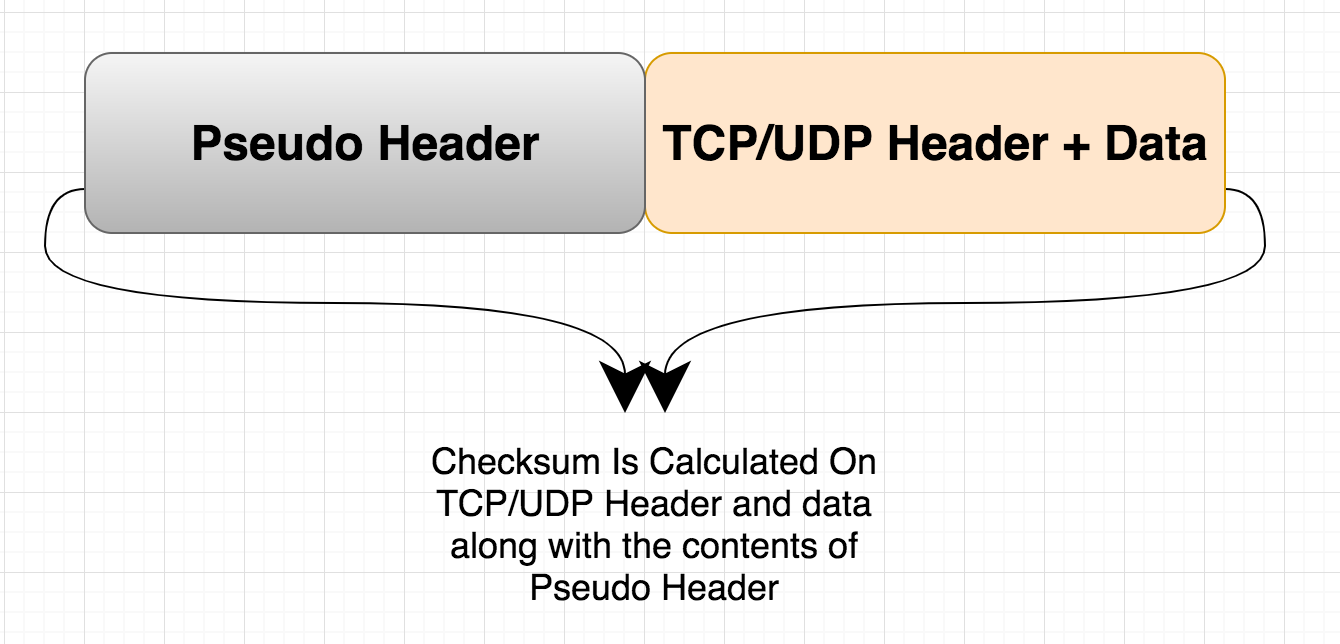
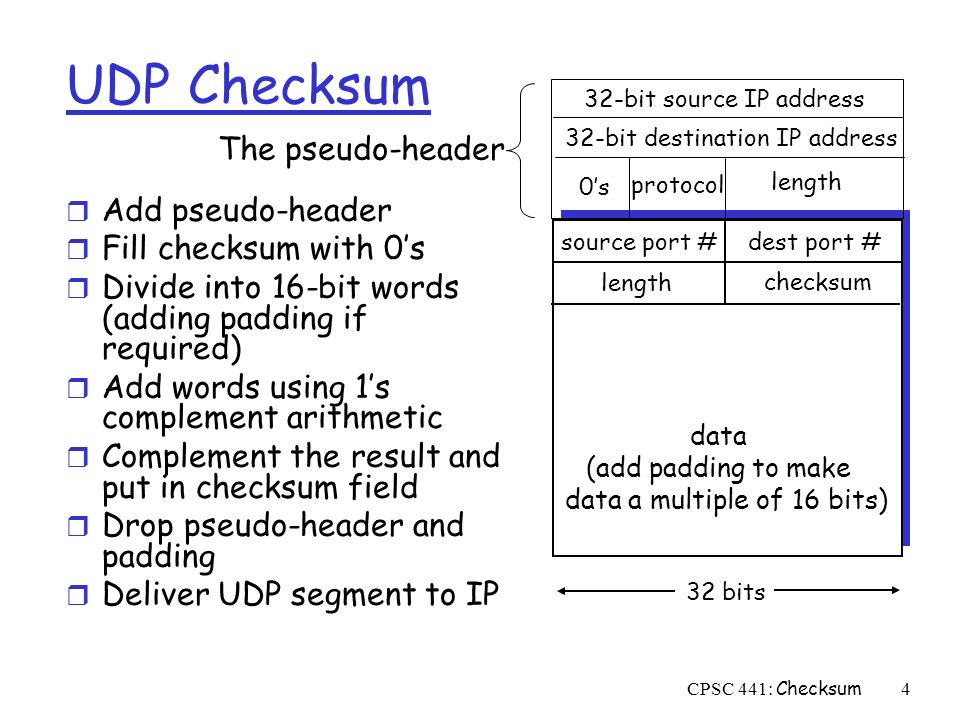
How is TCP & UDP Checksum Calculated?
Volume Shadow Copy
Volume Shadow Copy is a service that creates and maintains snapshots (“shadow copies”) of disk volumes
If you accidentally delete 10 pages of your dissertation, you can right-click the document, choose Restore previous versions, and access a previous version of it.
You can open it (in read-only mode) or copy it to a new location.
If you accidentally delete a file or folder, you can right-click the containing folder, choose Restore previous versions, and open the folder as it appeared at the time a shadow copy was made (see screenshot below).
http://blog.szynalski.com/2009/11/23/volume-shadow-copy-system-restore/
If you accidentally delete 10 pages of your dissertation, you can right-click the document, choose Restore previous versions, and access a previous version of it.
You can open it (in read-only mode) or copy it to a new location.
If you accidentally delete a file or folder, you can right-click the containing folder, choose Restore previous versions, and open the folder as it appeared at the time a shadow copy was made (see screenshot below).
http://blog.szynalski.com/2009/11/23/volume-shadow-copy-system-restore/
The Windows Registry
The Windows Registry is a collection of databases of configuration settings.
The Windows Registry is used to store much of the information and settings for software programs, hardware devices, user preferences, operating system configurations, and much more.
Registry Editor can be accessed by executing regedit from the Command Prompt
http://pcsupport.about.com/od/termsr/p/registrywindows.htm
The Windows Registry is used to store much of the information and settings for software programs, hardware devices, user preferences, operating system configurations, and much more.
Registry Editor can be accessed by executing regedit from the Command Prompt
http://pcsupport.about.com/od/termsr/p/registrywindows.htm
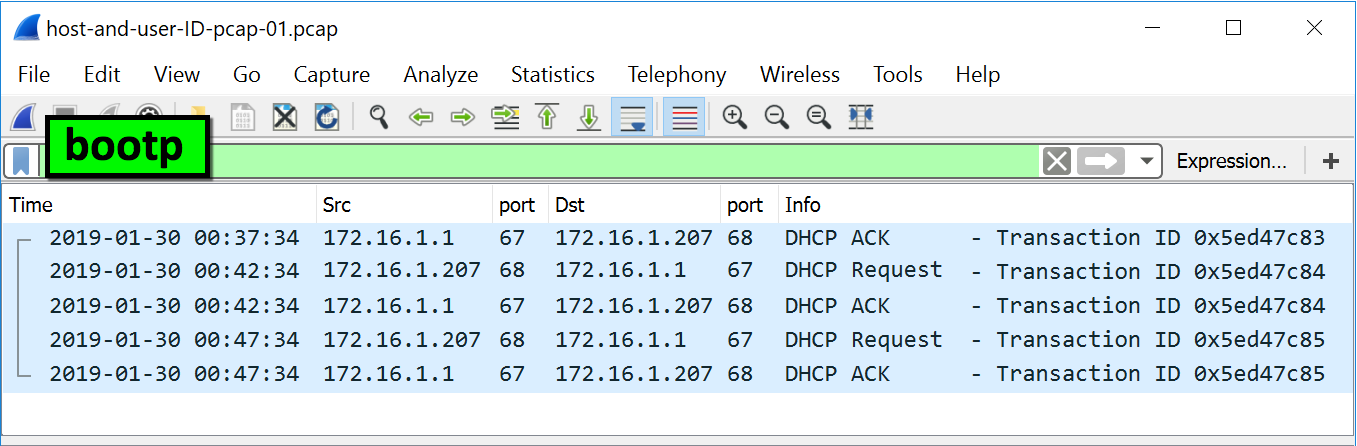
DHCP
- Dynamic Host Configuration Protocol (DHCP) is a network protocol that enables a server to automatically assign an IP address to a computer from a defined range of numbers (i.e., a scope) configured for a given network. When a computer uses a static IP address, it means that the computer is manually configured to use a specific IP address. One problem with static assignment, which can result from user error or inattention to detail, occurs when two computers are configured with the same IP address. This creates a conflict that results in loss of service. Using DHCP to dynamically assign IP addresses minimizes these conflicts. The purpose of DHCP is to ease administration of large networks. With static manual IP configuration you may get network conflict. http://kb.iu.edu/data/adov.html
- How does client know the IP address of DHCP server to send a DHCP Discover Message?
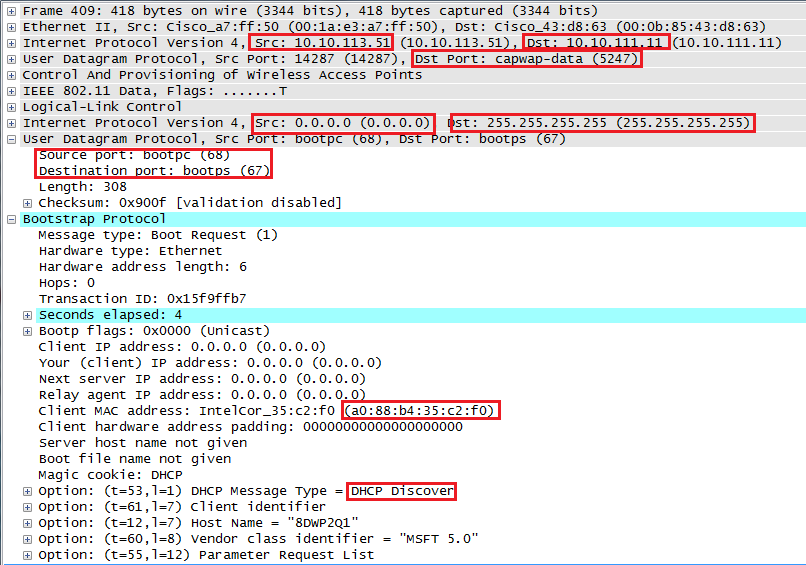
- DHCP Request Message


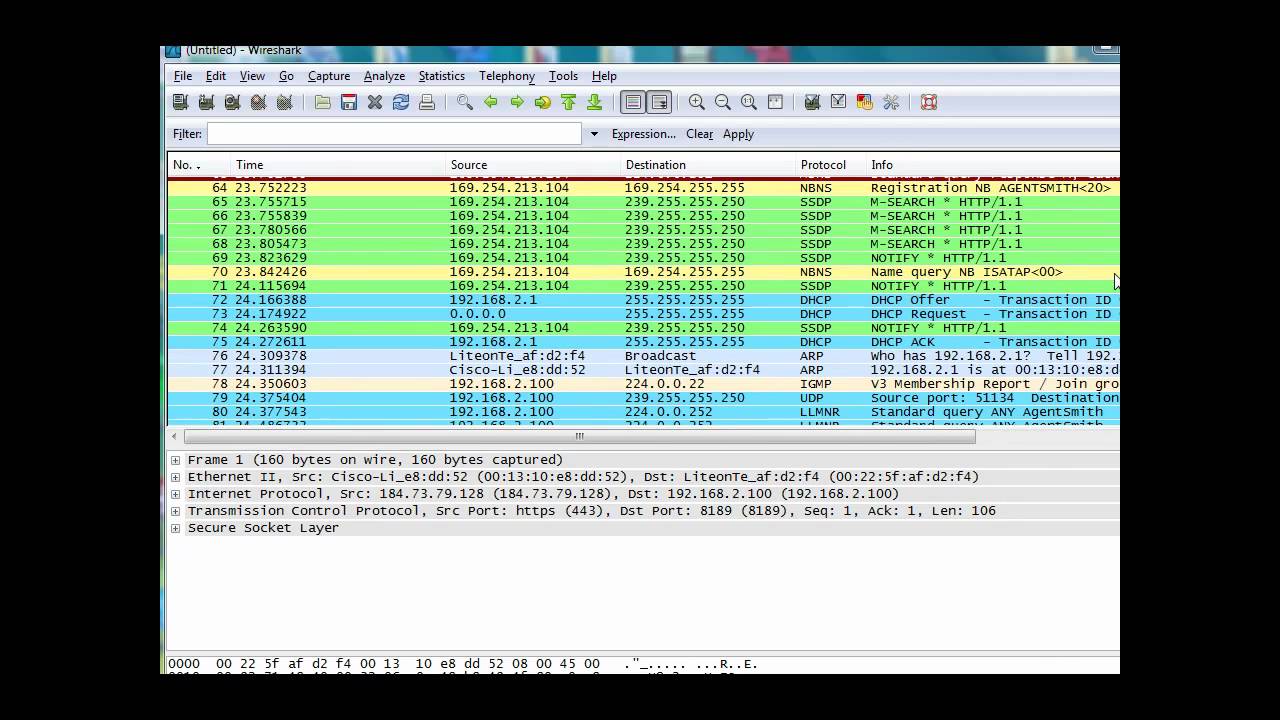
- How does DHCP (DORA) work?


- APIPA (Automatic Private IP Addressing)
Automatic Private IP Addressing (APIPA) is a feature in operating systems (such as Windows) that enables computers to automatically self-configure an IP address and subnet mask when their DHCP server isn’t reachable. The IP address range for APIPA is 169.254.0.1-169.254.255.254, with the subnet mask of 255.255.0.0.
https://study-ccna.com/apipa-automatic-private-ip-addressing/

Saturday, February 11, 2012
labeled and unlabeled break statements
Break should be used either with loop or switch.
Further more Break has two forms Labeled and Unlabeled.
Good example of unlabaled break is, tradional use with switch, loop.
Labeled switch can also be used if we have labeled statements.
Simply using 'break' is compilation error.
Reference:
http://docs.oracle.com/javase/tutorial/java/nutsandbolts/branch.html
Further more Break has two forms Labeled and Unlabeled.
Good example of unlabaled break is, tradional use with switch, loop.
Labeled switch can also be used if we have labeled statements.
Simply using 'break' is compilation error.
Reference:
http://docs.oracle.com/javase/tutorial/java/nutsandbolts/branch.html
Marker interface
an interface with no methods is called as marker interface
ex:
interface test{ }
Serializable, Clonable, SingleThreadModel are called marker interfaces in java. these marker interface's give additional information about the behavior of the class.
Marker interface is an empty interface. Eg is Serializable. When a class
implements this interface then only we can serialize the object. i.e
we can save in the file. In other words any class which implements
serializable can be serialized which is the additional feature when
compared with an ordianary object.
Simillarly when a class is implementing java.rmi.Remote it can be
used as a Remote object.
Reference:
http://geekexplains.blogspot.com/2009/10/marker-interface-in-java-what-why-uses.html
For example, if your class members contain system-dependant information that is only relevant on one machine (such as hardware info) or only during the scope of one app server's life-cycle (like session Ids) then you are provide the ability to NOT mark it as serializable, so that no code will attempt to serialize and de-serialize, which would result in logic or runtime errors later on.
Whereas if your data consists of transportable data such as names or phone numbers, you can mark it serializeable, thus indicating that all manners of transport utilizing serialization and de-serialization may be employed on this data to allow it to be moved between machines etc.
http://www.linkedin.com/groups/Why-serialization-use-marker-interface-70526.S.5853381965264211970?view=&gid=70526&type=member&item=5853381965264211970&trk=eml-anet_dig-b_nd-pst_ttle-cn
ex:
interface test{ }
Serializable, Clonable, SingleThreadModel are called marker interfaces in java. these marker interface's give additional information about the behavior of the class.
Marker interface is an empty interface. Eg is Serializable. When a class
implements this interface then only we can serialize the object. i.e
we can save in the file. In other words any class which implements
serializable can be serialized which is the additional feature when
compared with an ordianary object.
Simillarly when a class is implementing java.rmi.Remote it can be
used as a Remote object.
Reference:
http://geekexplains.blogspot.com/2009/10/marker-interface-in-java-what-why-uses.html
- Since the ability of a Class's data to be serialized and de-serialized correctly is implementation specific, it is necessary to be able to assert whether serialization is possible for this class.
For example, if your class members contain system-dependant information that is only relevant on one machine (such as hardware info) or only during the scope of one app server's life-cycle (like session Ids) then you are provide the ability to NOT mark it as serializable, so that no code will attempt to serialize and de-serialize, which would result in logic or runtime errors later on.
Whereas if your data consists of transportable data such as names or phone numbers, you can mark it serializeable, thus indicating that all manners of transport utilizing serialization and de-serialization may be employed on this data to allow it to be moved between machines etc.
http://www.linkedin.com/groups/Why-serialization-use-marker-interface-70526.S.5853381965264211970?view=&gid=70526&type=member&item=5853381965264211970&trk=eml-anet_dig-b_nd-pst_ttle-cn
Wednesday, January 11, 2012
integration frameworks
- Apache Camel
http://camel.apache.org/
Saturday, January 7, 2012
Decision Making Skills
- Using a DECISION MATRIX to help you to decide between alternatives:
SWOT analysis is a subjective method used to evaluate the STRENGTHS, WEAKNESSES, OPPORTUNITIES, and THREATS involved in trying to attain an objective
Reference:
http://www.kent.ac.uk/careers/sk/decisionmaking.htm#DECISION
- PEST analysis (political, economic, social and technological) describes a framework of macro-environmental factors used in the environmental scanning component of strategic management. It is part of an external analysis when conducting a strategic analysis or doing market research, and gives an overview of the different macro-environmental factors to be taken into consideration. It is a strategic tool for understanding market growth or decline, business position, potential and direction for operations.
- Identifying "Big Picture" Opportunities and Threats
https://www.mindtools.com/pages/article/newTMC_09.htm
business analyst role
What are the challenges a BA may need to overcome to respond to the increased expectations of companies who hire business analysts not just to manage requirements, but
also to perform project management and participate on decision-making processes?
To be truly effective, a BA must consider the project requirements their primary concern, from the development of a product vision and scope to detailed user and
software requirements specifications and the change control processes that will be used to manage requirements during the lifetime of the proj
Reference:
http://www.bridging-the-gap.com/expanding-the-business-analyst-role-good-or-bad/
also to perform project management and participate on decision-making processes?
To be truly effective, a BA must consider the project requirements their primary concern, from the development of a product vision and scope to detailed user and
software requirements specifications and the change control processes that will be used to manage requirements during the lifetime of the proj
Reference:
http://www.bridging-the-gap.com/expanding-the-business-analyst-role-good-or-bad/
preparation
Top 5 Job Interview Tips
http://career-advice.monster.co.uk/job-interview/preparing-for-job-interviews/top-5-job-interview-tips/article.aspx
Marketing Yourself Successfully - Video Advice
http://career-advice.monster.co.uk/job-interview/job-interview-behaviour/marketing-yourself-successfully-video/article.aspx
http://career-advice.monster.co.uk/job-interview/preparing-for-job-interviews/top-5-job-interview-tips/article.aspx
Marketing Yourself Successfully - Video Advice
http://career-advice.monster.co.uk/job-interview/job-interview-behaviour/marketing-yourself-successfully-video/article.aspx
What is the difference between an incremental backup and a differential backup?
An Incremental backup backs up only the selected files that have their archive bit set to ON, setting them back to OFF.
a backup of all files that are new or changed since the last backup whether it was a full or an incremental.
The advantage of an Incremental is that it takes the least amount of time and media of all the backup methods.
In the case of restoring with Incremental backups, all the Incremental backups since the last full backup plus the last full backup would be necessary.
A Differential backup backs up only the selected files that have their archive bit set to ON but does not set the archive bit back to OFF.
A Differential backup will back up all selected files that are new and changed since the last full backup.
at restore time; you'll need only the last full backup and the last differential to get a complete restore
Reference:
http://wiki.answers.com/Q/What_is_the_difference_between_an_incremental_backup_and_a_differential_backup
https://en.wikipedia.org/wiki/Continuous_Data_Protection

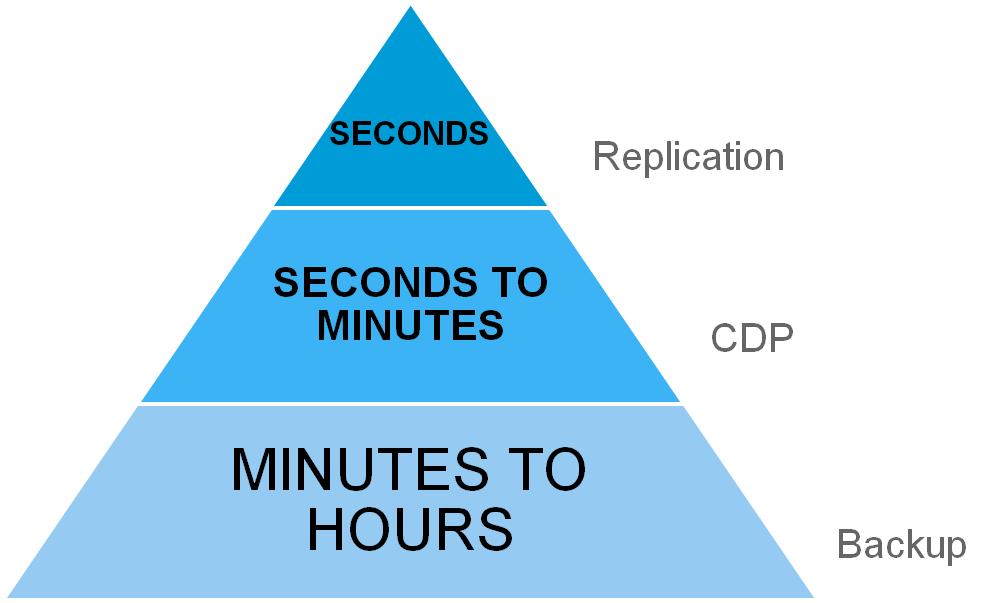
Simply stated, continuous data protection (CDP), also called continuous backup, is a storage system that backs up data whenever any change is made in it. In effect, CDP creates an electronic journal of complete storage snapshots, one for every instant in time that data modification occurs.
Why continuous data protection?
IT complexity: Continuous data protection helps ensure continuous availability of the varied, cross-platform environments.
Administrative capability:
Cost factor:Continuous data protection may prove to be a cheaper solution than traditional backup and recovery solutions. Software-based continuous data protection solutions today are easy to deploy and manage,
Data growth: Remote users in geographically dispersed locations have access to email, core systems and other mission-critical applications. In such cases, continuous data protection makes perfect sense for enterprises with locations in multiple geographies.
Criticality of data:Continuous data protection technologies enable seamless backup and restore at the backend without affecting end users. Many continuous data protection solutions can recover data from any point in time within less than a minute.
Most of the challenges with continuous data protection emanate from the environment being targeted. A true continuous data protection solution will support real-time protection rather than scheduled snapshots. The change rate of the data sets that are being protected could pose challenges to the continuous data protection solution.
https://www.computerweekly.com/tip/Continuous-data-protection-Do-you-need-it
a backup of all files that are new or changed since the last backup whether it was a full or an incremental.
The advantage of an Incremental is that it takes the least amount of time and media of all the backup methods.
In the case of restoring with Incremental backups, all the Incremental backups since the last full backup plus the last full backup would be necessary.
A Differential backup backs up only the selected files that have their archive bit set to ON but does not set the archive bit back to OFF.
A Differential backup will back up all selected files that are new and changed since the last full backup.
at restore time; you'll need only the last full backup and the last differential to get a complete restore
Reference:
http://wiki.answers.com/Q/What_is_the_difference_between_an_incremental_backup_and_a_differential_backup
- Continuous data protection (CDP), also called continuous backup or real-time backup, refers to backup of computer data by automatically saving a copy of every change made to that data, essentially capturing every version of the data that the user saves. In its true form it allows the user or administrator to restore data to any point in time
https://en.wikipedia.org/wiki/Continuous_Data_Protection
Why continuous data protection?
IT complexity: Continuous data protection helps ensure continuous availability of the varied, cross-platform environments.
Administrative capability:
Cost factor:Continuous data protection may prove to be a cheaper solution than traditional backup and recovery solutions. Software-based continuous data protection solutions today are easy to deploy and manage,
Data growth: Remote users in geographically dispersed locations have access to email, core systems and other mission-critical applications. In such cases, continuous data protection makes perfect sense for enterprises with locations in multiple geographies.
Criticality of data:Continuous data protection technologies enable seamless backup and restore at the backend without affecting end users. Many continuous data protection solutions can recover data from any point in time within less than a minute.
Most of the challenges with continuous data protection emanate from the environment being targeted. A true continuous data protection solution will support real-time protection rather than scheduled snapshots. The change rate of the data sets that are being protected could pose challenges to the continuous data protection solution.
https://www.computerweekly.com/tip/Continuous-data-protection-Do-you-need-it
SQL JOIN
- ChatGPT
SQL JOINs are used to combine rows from two or more tables based on a related column between them. Here’s an explanation of different types of SQL JOINs with Venn diagrams and examples:
1. INNER JOIN
Definition: An INNER JOIN returns records that have matching values in both tables. It retrieves only the rows that satisfy the join condition.
Venn Diagram:
- A (left table) ∩ B (right table) = Intersection
Example:
Consider two tables:
Employees
| ID | Name |
|---|---|
| 1 | Alice |
| 2 | Bob |
| 3 | Charlie |
Departments
| ID | EmployeeID | Department |
|---|---|---|
| 1 | 1 | HR |
| 2 | 2 | IT |
| 3 | 4 | Finance |
SELECT Employees.Name, Departments.Department
FROM Employees
INNER JOIN Departments ON Employees.ID = Departments.EmployeeID;
Result:
| Name | Department |
|---|---|
| Alice | HR |
| Bob | IT |
2. LEFT OUTER JOIN
Definition: A LEFT OUTER JOIN returns all records from the left table and the matched records from the right table. If there is no match, the result is NULL on the side of the right table.
Venn Diagram:
- A (left table) ∪ (A ∩ B) = Left table plus the intersection
SELECT Employees.Name, Departments.Department
FROM Employees
LEFT OUTER JOIN Departments ON Employees.ID = Departments.EmployeeID;
3. RIGHT OUTER JOIN
Definition: A RIGHT OUTER JOIN returns all records from the right table and the matched records from the left table. If there is no match, the result is NULL on the side of the left table.
Venn Diagram:
- B (right table) ∪ (A ∩ B) = Right table plus the intersection
SELECT Employees.Name, Departments.Department
FROM Employees
RIGHT OUTER JOIN Departments ON Employees.ID = Departments.EmployeeID;
4. FULL OUTER JOIN
Definition: A FULL OUTER JOIN returns all records when there is a match in either left or right table. It combines the results of both LEFT OUTER JOIN and RIGHT OUTER JOIN.
Venn Diagram:
- A (left table) ∪ B (right table) = Union of both tables
Example:
SQL Query:
SELECT Employees.Name, Departments.Department
FROM Employees
FULL OUTER JOIN Departments ON Employees.ID = Departments.EmployeeID;
Summary
- INNER JOIN: Retrieves only the rows with matching values in both tables (intersection).
- LEFT OUTER JOIN: Retrieves all rows from the left table and matching rows from the right table (left table plus intersection).
- RIGHT OUTER JOIN: Retrieves all rows from the right table and matching rows from the left table (right table plus intersection).
- FULL OUTER JOIN: Retrieves all rows from both tables, with
NULLwhere there are no matches (union of both tables).
- The SQL JOIN clause is used whenever we have to select data from 2 or more tables.
There are 2 types of SQL JOINS – INNER JOINS and OUTER JOINS.
The INNER JOIN will select all rows from both tables as long as there is a match between the columns we are matching on.
SQL OUTER JOIN and it has 2 sub-types called LEFT OUTER JOIN and RIGHT OUTER JOIN.
The LEFT OUTER JOIN or simply LEFT JOIN (you can omit the OUTER keyword in most databases),
selects all the rows from the first table listed after the FROM clause, no matter if they have matches in the second table.
The RIGHT OUTER JOIN or just RIGHT JOIN behaves exactly as SQL LEFT JOIN, except that it returns all rows from the second table (the right table in our SQL JOIN statement).
References:
http://www.sql-tutorial.net/SQL-JOIN.asp
http://www.quackit.com/sql/tutorial/sql_outer_join.cfm
http://www.tizag.com/sqlTutorial/sqljoin.php
http://www.sqltutorial.org/sqljoin-innerjoin.aspx
- INNER JOIN
SELECT Customers.*, Orders.* FROM Customers INNER JOIN Orders ON Customers.CustomerID =Orders.CustomerID
There is another way to visualize the SQL INNER JOIN by using the Venn diagrams

- LEFT OUTER JOIN
SELECT Customers.*, Orders.* FROM Customers LEFT OUTER JOIN Orders ON Customers.CustomerID =Orders.CustomerID
There is another way to visualize the SQL INNER JOIN by using the Venn diagrams

- RIGHT OUTER JOIN
SELECT Customers.*, Orders.* FROM Customers RIGHT OUTER JOIN Orders ON Customers.CustomerID =Orders.CustomerID
There is another way to visualize the SQL INNER JOIN by using the Venn diagrams

- FULL OUTER JOIN
There is another way to visualize the SQL INNER JOIN by using the Venn diagrams

- JOIN SCHEMA

- Using Cross Joins
A cross join that does not have a WHERE clause produces the Cartesian product of the tables involved in the join. The size of a Cartesian product result set is the number of rows in the first table multiplied by the number of rows in the second table.
The result set contains 170 rows (SalesPerson has 17 rows and SalesTerritory has 10; 17 multiplied by 10 equals 170).
http://msdn.microsoft.com/en-us/library/ms190690%28v=sql.105%29.aspx
The SQL CROSS JOIN produces a result set which is the number of rows in the first table multiplied by the number of rows in the second table, if no WHERE clause is used along with CROSS JOIN. This kind of result is called as Cartesian Product
http://www.w3resource.com/sql/joins/cross-join.php
- Cross join
CROSS JOIN returns the Cartesian product of rows from tables in the join. In other words, it will produce rows which combine each row from the first table with each row from the second table
CREATE TABLE department
(
DepartmentID INT,
DepartmentName VARCHAR(20)
);
CREATE TABLE employee
(
LastName VARCHAR(20),
DepartmentID INT
);
INSERT INTO department(DepartmentID, DepartmentName) VALUES(31, 'Sales');
INSERT INTO department(DepartmentID, DepartmentName) VALUES(33, 'Engineering');
INSERT INTO department(DepartmentID, DepartmentName) VALUES(34, 'Clerical');
INSERT INTO department(DepartmentID, DepartmentName) VALUES(35, 'Marketing');
INSERT INTO employee(LastName, DepartmentID) VALUES('Rafferty', 31);
INSERT INTO employee(LastName, DepartmentID) VALUES('Jones', 33);
INSERT INTO employee(LastName, DepartmentID) VALUES('Steinberg', 33);
INSERT INTO employee(LastName, DepartmentID) VALUES('Robinson', 34);
INSERT INTO employee(LastName, DepartmentID) VALUES('Smith', 34);
INSERT INTO employee(LastName, DepartmentID) VALUES('John', NULL);
Example of an explicit cross join:
SELECT *
FROM employee
CROSS JOIN department;
Example of an implicit cross join:
SELECT *
FROM employee, department;
Inner join
SELECT *
FROM employee
INNER JOIN department ON employee.DepartmentID = department.DepartmentID;
The following example is equivalent to the previous one, but this time using implicit join notation:
SELECT *
FROM employee, department
WHERE employee.DepartmentID = department.DepartmentID;
Left outer join
SELECT *
FROM employee
LEFT OUTER JOIN department ON employee.DepartmentID = department.DepartmentID;
Right outer join
SELECT *
FROM employee
RIGHT OUTER JOIN department ON employee.DepartmentID = department.DepartmentID;
Full outer join
SELECT *
FROM employee
FULL OUTER JOIN department ON employee.DepartmentID = department.DepartmentID;
Self-join
A self-join is joining a table to itself
SELECT F.EmployeeID, F.LastName, S.EmployeeID, S.LastName, F.Country
FROM Employee F
INNER JOIN Employee S ON F.Country = S.Country
WHERE F.EmployeeID < S.EmployeeID
ORDER BY F.EmployeeID, S.EmployeeID;
http://en.wikipedia.org/wiki/Join_%28SQL%29
- JOIN Three Tables
method 1
SELECT Orders.OrderID, Customers.CustomerName, Shippers.ShipperName
FROM ((Orders
INNER JOIN Customers ON Orders.CustomerID = Customers.CustomerID)
INNER JOIN Shippers ON Orders.ShipperID = Shippers.ShipperID);
method 2
SELECT tablo1.OrderID, tablo1.CustomerName, Shippers.ShipperName
FROM (select * from Orders INNER JOIN Customers ON Orders.CustomerID = Customers.CustomerID)
as tablo1
INNER JOIN Shippers ON tablo1.ShipperID = Shippers.ShipperID;
https://www.w3schools.com/sql/sql_join_inner.asp
Friday, January 6, 2012
The Key Differences Between SAN, DAS, and NAS
- Direct-Attached Storage
( DAS)
The most common form of server storage today is still direct attached storage.
The disks may be internal to the server or they may be in an array that
Either way,
An application server will have its own storage; the next application server will have its own storage;
and the file and print servers will each have their own storage
- Storage Area Networks
( SAN)
Data
The physical elements of the SAN (servers, switches, storage arrays, etc.)
Storage can
A storage area network (SAN) is a dedicated network that provides access to
In storage networking terminology, a Storage Area Network (SAN) is a high-speed subnetwork of shared storage devices. A storage device is a machine that contains nothing but a disk or disks for storing data.
A SAN's architecture works in a way that makes all storage devices available to all servers on
Because stored data does not
- Network Attached Storage
( NAS)
To prevent the proliferation of file servers, a single NAS appliance can replace many regular file servers, simplifying management and reducing cost and workload
NAS appliances are also
Reference:
http://smbtechconnect.securelement.com/2008/03/key-differences-between-san-das-and-nas.html
- An optical jukebox is a robotic data storage device that can automatically load and unload optical discs, such as Compact Disc, DVD, Ultra Density Optical or Blu-ray disc and can provide terabytes (TB) and
petabytes (PB) of tertiary storage.
https://en.wikipedia.org/wiki/Optical_jukebox
Subscribe to:
Posts (Atom)