symbolic link created for C:\TestFolder <<===>> C:\Users\Geek\TestFolder
Hard Link
A hard link directly points to the file, and acts to the operating system as if it is the file itself. You’ll want to use this option the majority of the time if you are trying to fake an application’s directory.
Soft Link
A soft link is essentially a shortcut to a file or folder – if you are using Windows explorer, you’ll be redirected to the directory if you double-click on a shortcut, it won’t pretend its part of the filesystem. You can still directly reference or open a file with the symlinked path, and it mostly works.
Deleting Symlinks
To delete a symlink, you can just delete the link. Just make sure you don’t delete the original file.
HSQLDB (HyperSQL DataBase) is the leading SQL relational database engine written in Java. It offers a small, fast multithreaded and transactional database engine with in-memory and disk-based tables and supports embedded and server modes. It includes a powerful command line SQL tool and simple GUI query tools.
http://hsqldb.org/
HSQLDB (Hyper Structured Query Language Database) is a relational database management system written in Java. It has a JDBC driver and supports a large subset of SQL-92 and SQL:2008 standards.[1] It offers a fast,[2] small (around 1300 kilobytes in version 2.2) database engine which offers both in-memory and disk-based tables. Both embedded and server modes are available for purchase.
Additionally, it includes tools such as a minimal web server, command line and GUI management tools (can be run as applets), and a number of demonstration examples. It can run on Java runtimes from version 1.1 upwards, including free Java runtimes such as Kaffe.
HSQLDB is available under a BSD license. It is used as a database and persistence engine in many open source software projects, such as OpenOffice Base, LibreOffice Base, and the Standalone Roller Demo,[3] as well as in commercial products, such as Mathematica or InstallAnywhere (starting with version 8.0)
http://en.wikipedia.org/wiki/HSQLDB
1. The dialect is set to the database we are using which is HSQLDB
2. The JDBC driver is also set to HSQLDB
3. We set the database to one called testdb and request that the database be shutdown when our program exits
4. The default user name and passwords are used (change if yours differs)
5. I use the create-drop option to create the database and table(s) if they doesn’t exist, if they do they are dropped leaving me with a clean database each time I run the program. Other options are: create, update and validate
http://www.giantflyingsaucer.com/blog/?p=2902
querying using hsql database manager :
select your connection
type: HSQL DATABASE ENGINE SERVER
Driver: jdbc.hsqldb.jdbcDriver
URL: jdbc:hsqldb:hsql://localhost/
When writing a library it is very useful to log information. However there are many logging implementations out there, and a library cannot impose the
use of a particular one on the overall application that the library is a part of.
The Logging package is an ultra-thin bridge between different logging implementations. A library that uses the commons-logging API can be used with any
logging implementation at runtime. Commons-logging comes with support for a number of popular logging implementations, and writing adapters for others
is a reasonably simple task.
Applications (rather than libraries) may also choose to use commons-logging. While logging-implementation independence is not as important for
applications as it is for libraries, using commons-logging does allow the application to change to a different logging implementation without
recompiling code.
Note that commons-logging does not attempt to initialise or terminate the underlying logging implementation that is used at runtime; that is the
responsibility of the application. However many popular logging implementations do automatically initialise themselves; in this case an application may
be able to avoid containing any code that is specific to the logging implementation used.
6 cell 2 1/2 hrs
9 cell 4 1/2 hrs
12 cell 4 hrs plus
depending on your power saving options
the higher the cell capacity the higher/heavier the price.
http://answers.yahoo.com/question/index?qid=20091001184320AAmwNsS
I logged a support ticket at Quest. The support over there is really quick and helpful. In less than a day I got a message back that they were going to try it themselves, it went even to the technical people (development team) and after a few mails of back and for I got this final message: "Unfortunately, it was confirmed by our team's technical lead that Toad version 9.5 only support Oracle server 11g and not Oracle client 11g. My only suggestion for you is to install another client on your machine that is 10gR2 version or lower."
The Oracle System ID (SID) is used to uniquely identify a particular database on a system. For this reason, one cannot have more than one database with the same SID on a computer system.
When using RAC, all instances belonging to the same database must have unique SID's.
JFreeChart is a free 100% Java chart library that makes it easy for developers to display professional quality charts in their applications. JFreeChart's extensive feature set includes:
http://www.jfree.org/jfreechart/
BIRT is an open source Eclipse-based reporting system that integrates with your Java/Java EE application to produce compelling reports.
http://www.eclipse.org/birt/phoenix/
The JasperReports Library is the world's most popular open source reporting engine. It is entirely written in Java and it is able to use data coming from any kind of data source and produce pixel-perfect documents that can be viewed, printed or exported in a variety of document formats including HTML, PDF, Excel, OpenOffice and Word.
Jaspersoft Studio is the new Eclipse-based report designer for JasperReports and JasperReports Server.
It is a full rewrite of iReport Designer, available as Eclipse plugin, and as a standalone application http://community.jaspersoft.com/project/jaspersoft-studio
Copy backup
A copy backup copies all the files you select, but does not mark each file as having been backed up (in other words, the archive attribute is not cleared). Copying is useful if you want to back up files between normal and incremental backups because copying does not affect these other backup operations.
Daily backup
A daily backup copies all the files that you select that have been modified on the day the daily backup is performed. The backed-up files are not marked as having been backed up (in other words, the archive attribute is not cleared).
Normal backup A normal backup copies all the files you select and marks each file as having been backed up (in other words, the archive attribute is cleared). With normal backups, you only need the most recent copy of the backup file or tape to restore all of the files. You usually perform a normal backup the first time you create a backup set.
A differential backup is a type of data backup that preserves data, saving only the difference in the data since the last full backup
A differential backup is a cumulative backup of all changes made since the last full backup, i.e., the differences since the last full backup.
The advantage to this is the quicker recovery time, requiring only a full backup and the last differential backup to restore the entire data repository.
The disadvantage is that for each day elapsed since the last full backup, more data needs to be backed up, especially if a significant proportion of the data has changed, thus increasing backup time as compared to the incremental backup method.
http://en.wikipedia.org/wiki/Differential_backup
Incremental backup
An incremental backup is one that provides a backup of files that have changed or are new since the last incremental backup
it is one that backs up only the data that changed since the last backup — be it a full or incremental backup
The most basic form of incremental backup consists of identifying, recording and, thus, preserving only those files that have changed since the last backup. Since changes are typically low, incremental backups are much smaller and quicker than full backups. For instance, following a full backup on Friday, a Monday backup will contain only those files that changed since Friday. A Tuesday backup contains only those files that changed since Monday, and so on. A full restoration of data will naturally be slower, since all increments must be restored
http://en.wikipedia.org/wiki/Incremental_backup
An Incremental backup backs up only the selected files that have their archive bit set to ON, setting them back to OFF.
a backup of all files that are new or changed since the last backup whether it was a full or an incremental.
The advantage of an Incremental is that it takes the least amount of time and media of all the backup methods. In the case of restoring with Incremental backups, all the Incremental backups since the last full backup plus the last full backup would be necessary.
A Differential backup backs up only the selected files that have their archive bit set to ON but does not set the archive bit back to OFF.
A Differential backup will back up all selected files that are new and changed since the last full backup.
at restore time; you'll need only the last full backup and the last differential to get a complete restore
Bacula is a set of Open Source, computer programs that permit you (or the system administrator) to manage backup, recovery, and verification of computer data across a network of computers of different kinds
http://blog.bacula.org/
Bacula is an open source network backup solution that allows you create backups and perform data recovery of your computer systems.
it follows the server-client backup model;
we will focus more on the backup server and the backup clients than the individual Bacula components.
A Bacula server, which we will also refer to as the "backup server", has these components:
Bacula Director (DIR): Software that controls the backup and restore operations that are performed by the File and Storage daemons
Storage Daemon (SD): Software that performs reads and writes on the storage devices used for backups
Catalog: Services that maintain a database of files that are backed up. The database is stored in an SQL database such as MySQL or PostgreSQL
Bacula Console: A command-line interface that allows the backup administrator to interact with, and control, Bacula Director
Note: The Bacula server components don't need to run on the same server, but they all work together to provide the backup server functionality.
A Bacula client, i.e. a server that will be backed up, runs the File Daemon (FD) component.
Daemon is software that provides the Bacula server (the Director, specifically) access to the data that will be backed up.
By default, Bacula is set to use the PostgreSQL library.
https://www.digitalocean.com/community/tutorials/how-to-install-bacula-server-on-centos-7
Amanda Community Edition
Amanda Community Edition is a free and stable version of the world's most popular open source backup and recovery software Amanda. The Amanda project started at the University of Maryland in 1991. Over the years hundreds of developers contributed to the project
https://www.zmanda.com/amanda-community-edition.html
In computer science, a priority queue is an abstract data type which is like a regular queue or stack data structure, but where additionally each element has a "priority" associated with it. In a priority queue, an element with high priority is served before an element with low priority. If two elements have the same priority, they are served according to their order in the queue.
stack — elements are pulled in last-in first-out-order (e.g. a stack of papers)
queue — elements are pulled in first-in first-out-order (e.g. a line in a cafeteria)
It is a common misconception that a priority queue is a heap. A priority queue is an abstract concept like "a list" or "a map"; just as a list can be implemented with a linked list or an array, a priority queue can be implemented with a heap or a variety of other methods.
This is also known as "pop_element(Off)", "get_maximum_element", or "get_front(most)_element".
Some conventions reverse the order of priorities, considering lower values to be higher priority, so this may also be known as "get_minimum_element", and is often referred to as "get-min" in the literature.
This may instead be specified as separate "peek_at_highest_priority_element" and "delete_element" functions, which can be combined to produce "pull_highest_priority_element".
In addition, peek (in this context often called find-max or find-min), which returns the highest priority element but does not modify the queue, is very frequently implemented, and nearly always executes in O(1) time. This operation and its O(1) performance is crucial to many applications of priority queues.
Using a priority queue to sort
he semantics of priority queues naturally suggest a sorting method: insert all the elements to be sorted into a priority queue, and sequentially remove them; they will come out in sorted order. This is actually the procedure used by several sorting algorithms, once the layer of abstraction provided by the priority queue is removed
Heapsort if the priority queue is implemented with a heap.
Smoothsort if the priority queue is implemented with a Leonardo heap.
Selection sort if the priority queue is implemented with an unordered array.
Insertion sort if the priority queue is implemented with an ordered array.
Tree sort if the priority queue is implemented with a self-balancing binary search tree.
Applications
Bandwidth management
Priority queuing can be used to manage limited resources such as bandwidth on a transmission line from a network router.
Dijkstra's algorithm
When the graph is stored in the form of adjacency list or matrix, priority queue can be used to extract minimum efficiently when implementing Dijkstra's algorithm, although one also needs the ability to alter the priority of a particular vertex in the priority queue efficiently.
Huffman coding
Huffman coding requires one to repeatedly obtain the two lowest-frequency trees. A priority queue makes this efficient.
3. A bit stream 10011101 is transmitted using the standard CRC method. The generator polynomial is x3+1. Show the actual bit string transmitted. Suppose the third bit from the left is inverted during
transmission. Show that this error is detected at the receiver’s end.
Solution:
Message M (x) = 10011101 = x7+x4+ x3+ x2+ 1
CRC Polynomial C (x) = x3+ 1 = 1001
Multiply the message with x3 since the divisor polynomial is of degree 3.
Since T (x) minus the remainder would be exactly divisible by C (x), we subtract the remainder from T (x) as shown below:
Note: The minus operation in polynomial arithmetic is the logical XOR operation.
T (x): 10011101000
Remainder: 100
-------------------
10011101100 ? This turns out to be the original message with
------------------- the remainder appended to it.
If the third bit form the left is inverted during transmission, the bit stream would be: 10111101100. Dividing this by 1001 we get:
10101
---------------------------------------------
1001 | 10111101100 ? Message
| 1001
-----------------
1011
1001
---------
1001
1001
------------
0100 ? Remainder
------------
Since the remainder is 100, which is different form 0, the receiver detects the error and can ask for retransmission.
Goal Maximize protection, Minimize extra bits Idea Add k bits of redundant data to an n-bit message N-bit message is represented as a n-degree polynomial with each bit in the message being the corresponding coefficient in the polynomial Example Message = 10011010 Polynomial = 1 ?x7 ? 0 ?x6 ? 0 ?x5 ? 1 ?x4 ? 1 ?x3 ? 0 ?x2 ? 1 ?x ? 0 = x7 ? x4 ? x3 ? x
Cyclic Redundancy Check
Error Detection Checked at many layers ? Physical (e.g. modulation) ? Datalink (e.g. cyclic redundancy check) ? Network/Transport (e.g. IP Checksum) ? Application (e.g. MD5 hash)
In computer security, a DMZ (sometimes referred to as a perimeter network) is a physical or logical subnetwork that contains and exposes an organization's external-facing services to a larger untrusted network, usually the Internet. The purpose of a DMZ is to add an additional layer of security to an organization's local area network (LAN); an external attacker only has access to equipment in the DMZ, rather than any other part of the network. The name is derived from the term "demilitarized zone", an area between nation states in which military action is not permitted.
Services in the DMZ
Any service that is being provided to users on the external network can be placed in the DMZ. The most common of these services are:
Web servers
Mail servers
FTP servers
VoIP servers
Web servers that communicate with an internal database require access to a database server, which may not be publicly accessible and may contain sensitive information. The web servers can communicate with database servers either directly or through an application firewall for security reasons.
E-mail messages and particularly the user database are confidential information, so they are typically stored on servers that cannot be accessed from the Internet (at least not in an insecure manner), but can be accessed from the SMTP[clarify] servers that are exposed to the Internet.
The mail server inside the DMZ passes incoming mail to the secured/internal mail servers. It also handles outgoing mail.
For security, legal compliance[clarify] and monitoring reasons, in a business environment, some enterprises install a proxy server within the DMZ. This has the following consequences:
Obliges the internal users (usually employees) to use the proxy to get Internet access.
Allows the company to reduce Internet access bandwidth requirements because some of the web content may be cached by the proxy server.
Simplifies the recording and monitoring of user activities and block content violating acceptable use policies.
A reverse proxy server, like a proxy server, is an intermediary, but is used the other way around. Instead of providing a service to internal users wanting to access an external network, it provides indirect access for an external network (usually the Internet) to internal resources. For example, a back office application access, such as an email system, could be provided to external users (to read emails while outside the company) but the remote user would not have direct access to their email server. Only the reverse proxy server can physically access the internal email server. This is an extra layer of security, which is particularly recommended when internal resources need to be accessed from the outside. Usually such a reverse proxy mechanism is provided by using an application layer firewall as they focus on the specific shape of the traffic rather than controlling access to specific TCP and UDP ports as a packet filter firewall does.
Architecture
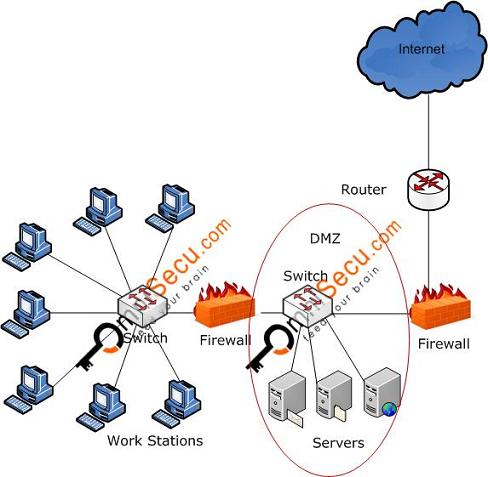
There are many different ways to design a network with a DMZ. Two of the most basic methods are with a single firewall, also known as the three legged model, and with dual firewalls.
Single firewall A single firewall with at least 3 network interfaces can be used to create a network architecture containing a DMZ. The external network is formed from the ISP to the firewall on the first network interface, the internal network is formed from the second network interface, and the DMZ is formed from the third network interface. The firewall becomes a single point of failure for the network and must be able to handle all of the traffic going to the DMZ as well as the internal network. The zones are usually marked with colors -for example, purple for LAN, green for DMZ, red for Internet (with often another color used for wireless zones).
Dual firewall
A more secure approach is to use two firewalls to create a DMZ. The first firewall (also called the "front-end" firewall) must be configured to allow traffic destined to the DMZ only. The second firewall (also called "back-end" firewall) allows only traffic from the DMZ to the internal network. This setup is considered more secure since two devices would need to be compromised. There is even more protection if the two firewalls are provided by two different vendors, because it makes it less likely that both devices suffer from the same security vulnerabilities.
In a typical DMZ configuration for a small company, a separate computer (or host in network terms) receives requests from users within the private network for access to Web sites or other companies accessible on the public network. The DMZ host then initiates sessions for these requests on the public network. However, the DMZ host is not able toinitiate a session back into the private network. It can only forward packets that have already been requested
One of the longstanding problems with the SELinux network access controls was that they lacked any ability to control packets at the network interface level, limiting our ability to provide access control based on the physical network and making it impossible to provide access control for forwarded packets
The network ingress/egress controls were designed to solve these problems by placing SELinux network access controls at the network interface level.
The new ingress/egress controls are fairly simple: each packet entering the system must pass an ingress access control and each packet leaving the system must pass an egress access control. Forwarded packets must also pass an additional forwarding access control
https://paulmoore.livejournal.com/2128.html
What are Access Control Lists?
ACLs are a network filter utilized by routers and some switches to permit and restrict data flows into and out of network interfaces. When an ACL is configured on an interface, the network device analyzes data passing through the interface, compares it to the criteria described in the ACL, and either permits the data to flow or prohibits it.
Why Do We Use Access Control Lists?
The primary reason is to provide a basic level of security for the network.
ACLs are not as complex and in depth of protection as stateful firewalls, but they do provide protection on higher speed interfaces where line rate speed is important and firewalls may be restrictive ACLs are also used to restrict updates for routing from network peers and can be instrumental in defining flow control for network traffic
When do we use Access Control Lists?
they do offer a significant amount of firewall capability
ACLs should be placed on external routers to filter traffic against less desirable networks and known vulnerable protocols.
One of the most common methods in this case is to setup a DMZ, or de-militarized buffer zone in your network. This architecture is normally implemented with two separate network devices.
The most exterior router provides access to all outside network connections. This router usually has less restrictive ACLs, but provides larger protection access blocks to areas of the global routing tables that you wish to restrict.
This router should also protect against well known protocols that you absolutely do not plan to allow access into or out of your network
ACLs here should be configured to restrict network peer access and can be usedin conjunction with the routing protocols to restrict updates and the extent of routes received from or sent to network peers.
The DMZ is where most IT professionals place systems which need access from the outside. The most common examples of these are web servers, DNS servers, and remote access or VPN systems.
The internal router of a DMZ contains more restrictive ACLs designed to protect the internal network from more defined threats.
ACLs here are often configured with explicit permit and deny statements for specific addresses and protocol services.
As you can see from this diagram, ingress traffic flows from the network into the interface and egress flows from the interface to the network.
ACLs start with a source address first in their configuration and destination second
As you configure an ACL on the ingress of a network interface it is important to recognize that all local network or hosts should be seen as sources here, and the exact opposite for the egress interface.
the implementation of ACLs on the interface of a router that faces an external network
the ingress side is coming from the outside network and those addresses are consideredto be sources, while all internal network addresses are destinations
the egress side, your internal network addresses are now source addresses and the external addresses are now destinations.
Honeypots, the simplest technology, work by tricking a hacker into thinking that they succeeded in infiltrating a system, when in reality the perpetrator reached the 'honeypot', which mimics the target server and provides the hacker with fake 'trophy' information while at the same time studying the behavior of the hacker and logging its IP address for law enforcement authorities to persecute
Honeyd, for instance, can create multiple different honeypots, called virtual honeypots.
Traditionally, a honeypot was a physical computer which simulated the operating system of the real server, but which was actually safely positioned outside the firewall Honeyd's invention of the virtual honeypot was a huge advancement because as a result, a company could have multiple honeypot traps covering all unused or unauthorized IP addresses, and not just one, which they hoped the attacker would choose
When a hacker attempts to connect to an IP address that a company doesn't authorize, Honeyd "takes over" that IP address using ARP spoofing (modifying the source IP address number in the communications packet) and assigns a virtual honeypot for the hacker to interact with. If the hacker probed a different unused IP, Honeyd would assign a different virtual honeypot with perhaps a different operating system or applications to remain realistic
Heat seeking honeypots will contain a module identifying web pages that hackers find "trendy", and which are commonly attacked
This module uses a series of algorithms to "search logs of the Bing search engine to identify queries used by attackers"
The program then mimics the web page at a location near the target server, interacts with the hacker "without manually setting up the actual software that is targeted"
In some versions of this technology, the program "trains" itself to act like the targeted website by employing natural language processing to "generate responses to attacker requests"
Researchers at the Pacific Northwest National Laboratory are building a reasoning framework called CHAMPION, which acts within a network and identifies potential attackers. The laboratory employs behavioral psychologists to determine which factors are most likely to prompt an employee to launch an attack against his own company
Then, CHAMPION combines data such as email traffic, calendars, and evaluation reports into a set of observations falling into four categories: employee role patterns, psychosocial patterns, policy violation patterns, and web access patterns
It then compares these observations to a database of indicators, and it labels individuals that fit the description of an attacker as dangerous
One of the most recurring themes in the field of decoy-based cyber security is targeting human error, rather than computer error, which occurs much less often.
http://www.pitt.edu/~cdv16/trends.htm
The DMZ or the Demilitarized Zone in a network refers to a segment of a network in which we place all the servers that need to be accessible from the internet
In either of these scenarios, whether we have only one firewall in a three-legged design or we have two back-to-back firewalls in the other design, our DMZ is going tobe placed behind only one firewall
But the question is what if there was a pretty critical server placed in the DMZ and we needed more than one layer of security in order to protect it? What if one of our firewalls which is placed in the front is a pretty old one and not capable of doing a very good logging and auditing of the kind of attacks on the DMZ?
In such cases, we need to come up with another design and combine the back-to-back and three-legged firewall designs to create something that satisfies our needs for better security of DMZ
In this scenario let’s say both of our firewalls are Forefront TMG 2010 and one of them acts as the front-end firewall connecting from one side to the Internet and from the other side to the back-end TMG.
The back-end firewall is going to be a three-legged firewall with:
One leg connecting to the LAN
One leg connecting to the DMZ
One leg leg connecting to the front-end TMG
The DMZ is placed behind two firewalls: The front-end TMG and the back-end TMG and if the user is going to reach the DMZ from the internet, he will have to pass through two firewalls
The LAN is also behind two firewalls and therefor better protected
Do you want to consider putting honeypots in your network? The network segment between the firewalls is the best place… The hackers expect the DMZ servers to be there
Specifically, we present heat-seeking honeypots that actively attract attackers, dynamically generate and deploy honeypot pages, then analyze logs to identify attack patterns.
In our design, the heat-seeking honeypots have four components. The first component is to identify which types of Web services the attackers are actively targeting. The second component is to automatically set up Web pages that match attackers’ interests. The third component advertises
honeypot pages to the attackers. When the honeypot receives traffic from attackers, it uses a sandboxed environment to log all accesses. Finally, the fourth component embodies methods to distinguish attacks from normal users and crawler visits, and to perform attack study
Comparing honeypots
we look at how effective different honeypot
setups are in terms of attracting attackers.
1.Web server:
Here, we have just a Web server (in
our case, Apache) running on a machine that can be
publicly accessed on the Internet. The machine has no
hostname, so the only way to access the machine is by
its IP address. There are no hyperlinks pointing to the
server, so it is not in the index of any search engine or
crawler.
2.Vulnerable software:
We install four commonly targeted Web applications, as described in Section 3.2 (a).
The application pages are accessible on the Internet,
and there are links to them on public Web sites. There-
fore, they are crawled and indexed by the search engines.
3.Heat-seeking honeypot pages:
These pages are generated by option (b) as described in Section 3.2. They
are simple HTML pages, wrapped in a small PHP
script which performs logging. Similar to software
pages, the honeypot pages are also crawled and indexed by search engines
the release of Symantec Decoy Server, a "honeypot" intrusion detection system (IDS) that detects, contains and monitors unauthorized access and system misuse as it happens. As a complement to host- and network-based IDS, Symantec Decoy Server diverts attacks from key resources while also providing early detection of internal and external attacks.
"Honeypots supplement security solutions such as firewalls and other intrusion detection systems, providing advanced decoy technology and early detection sensors. In addition to the forensic elements, honeypots can be used as a tool for reducing false positives,"
Symantec Decoy Server is not signature-based, so it automatically detects unknown attacks without any need for security signature updates or dynamic policy configurations. It also detects both host- and network-based attacks, unauthorized use of passwords and server access for increased network protection.
Once a decoy server has been attacked, it covertly monitors the activities of an attacker in real-time using Session Replay, a live session analysis tool. Sessions may be recorded and played back for further analysis to help organizations understand the tools and tactics used against them.
Symantec Decoy Server provides early detection of threats and enables attack diversion and confinement by actually becoming the target of the attack. The decoy sensor acts like a fully functioning server and can simulate email traffic between users in the organization to mirror the appearance of a live mail server.
http://www.symantec.com/region/au_nz/press/au_030701c.html
A honeypot is a system that's put on a network so it can be probed and attacked.
There are two types of honeypots:
Research: For example, the Honeynet Project is a volunteer, nonprofit security research organization that uses honeypots to collect information on cyberthreats.
Production: production honeypots are being recognized for the detection capabilities they can provide and for the ways they can supplement both network- and host-based intrusion protection.
A low-interaction system offers limited activity; in most cases, it works by emulating services and operating systems.
high-interaction honeypots involve real operating systems and applications, and nothing is emulated
Advantages of honeypots
Too much data: One of the common problems with the traditional IDS is that it generates a huge amount of alerts. In contrast, honeypots collect data only when someone is interacting with them.
False positives: Perhaps the biggest drawback of an IDS is that so many of the alerts generated are false.Honeypots sidestep this problem because any activity with them is, by definition, unauthorized.
False negatives: IDS technologies can also have difficulty identifying unknown attacks or behavior. Again, any activity with a honeypot is anomalous, making new or previously unknown attacks stand out
Resources: An IDS requires resource-intensive hardware to keep up with an organization's network traffic. According to Lance Spitzner, founder of the Honeynet Project, a single Pentium computer with 128MB of RAM can be used to monitor millions of IP addresses.
Encryption: more and more attackers are using encryption as well. That blinds an IDS's ability to monitor the network traffic. With a honeypot, it doesn't matter if an attacker is using encryption; the activity will still be captured
The functionality of honeypots is so diverse that it has been a challenge to define exactly what a honeypot is: honeypots serve many different purposes for different organizations. Generally, a honeypot is an information system resource whose value lies in unauthorized or illicit use of that resource.
In fact, its value lies in its being misused.
A dedicated server
A simulated system or state machine like deception tool kit[4] or KFSsensor[5]
A service on a selected host, like Tiny Honeypot that listens to ports not in legitimate use[6]
A virtual server, such as the original honeynet[7] and most other honeypots
A single file with special attributes which is sometimes called a honeytoken[8] or any number of other possibilities
The value in a honeypot is derived from the lack of any authorized activity to the resource. A honeypot resource is never meant for legitimate use; therefore, any use of the honeypot resource is illegitimate and accidental, or hostile in nature.
In the field of computer security, honeytokens are honeypots that are not computer systems.
Honeytokens are fictitious words or records that are added to legitimate databases.
They allow administrators to track data in situations they wouldn't normally be able to track, such as cloud-based networks. If data is stolen, honeytokens allow administrators to identify who it was stolen from or how it was leaked. If there are three locations for medical records, different honey tokens in the form of fake medical records could be added to each location. Different honeytoken would be in each set of records.
https://en.wikipedia.org/wiki/Honeytoken
A honeytoken is a data or a computing resource that exists for the purpose of alerting you when someone accesses it. This type of a honeypot could take many forms, such as a user account that no one should use, a file that no one should access and a link on which no one should click.