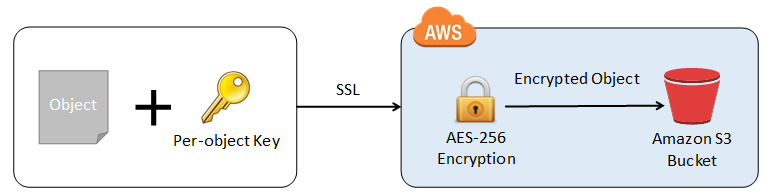
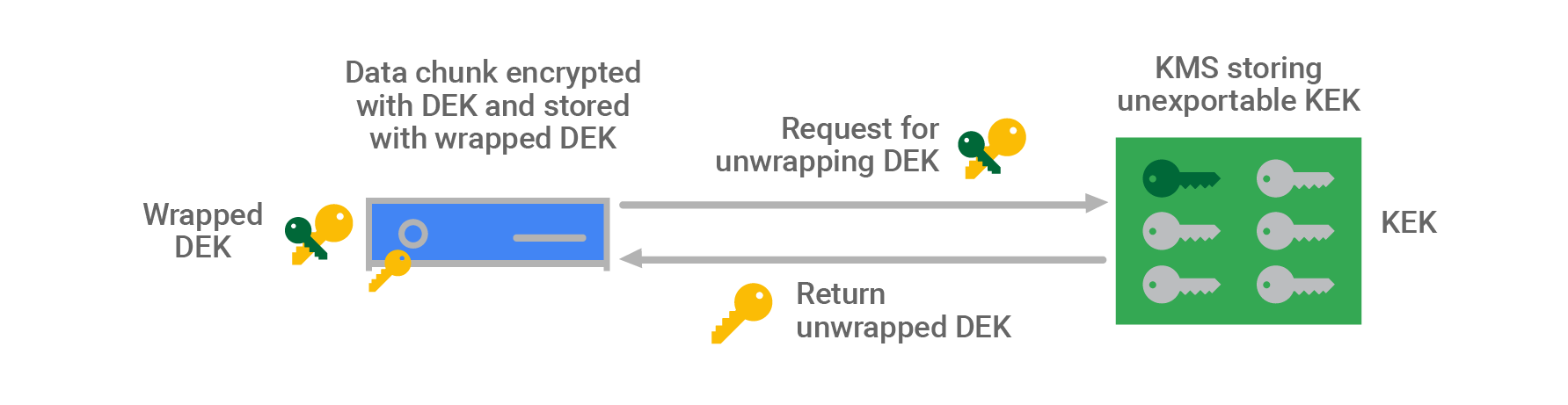
a diagram of how Amazon Web Services leverages envelope encryption
- Given its capability to make data unreadable to those who do not have the key to unlock it, encryption can actually be a powerful tool for protecting data confidentiality.
We are now moving to a world where every piece of data will
be encrypted, whether in transit between devices or stored at rest in your servers
Note that while
the series is focused on encryption of data at rest, the principles discussed will broadly cover encrypting data in transit.
Encryption can be defined as the use of mathematical functions/algorithms to make data unreadable
in order to disguise it from unauthorized actors.
Decryption transforms the disguised data back into readable data.
Plaintext is the
unencrypted data or message. It can refer to the data prior to encryption or after it has
been decrypted.
Ciphertext is
the is the encrypted data or message.
A Cipher Is the mathematical function/algorithm that does the actual encryption and decryption.
A Key is a value that serves as input to the cipher and must
used to decrypt ciphertext
In short, the encryption process takes a key (K) and inputs it into the cipher (CI) along with the plaintext (P) to create the ciphertext (C).
The decryption process is essentially the inverse with the key (K)
being used as an input into the cipher (CI) to transform ciphertext (C) back to plaintext (P).
While early data encryption relied on the secrecy of the cipher to maintain the security of the system, that has changed over time as
it has been shown that any cryptosystem, relying on the secrecy of its algorithm, can
be cracked.
“A cryptosystem should be secure even if everything about the system, except the key, is public knowledge.”
Today, cipher algorithms are
largely open standard and
it is generally acknowledged that the security of any cryptosystem relies on the strength of the cipher and of the encryption key.
Ciphers such as AEs-256 and RSA-2048
can potentially generate
ciphertext that takes more time to break than the current age of the universe.
Symmetric or Secret Key Encryption
The same key is used for both encrypting and decrypting data
Here’s an example of how to create a plaintext file and then encrypt it with a 128-bit symmetric key;
the openssl command should be fairly easy to understand. You may notice that the encryption command includes an -iv switch followed by a random string of characters.
To decrypt the ciphertext, you just use the decrypt -d option and supply the same symmetric key used to encrypt the original plaintext file.
The challenge with the symmetric key encryption approach is around key storage and management. The secret key has to
be carefully protected and distributed securely to all parties that need to encrypt or decrypt data. If
the key is lost, then the data is unreadable and if a malicious actor gains access to the key, they will have full access to the data.
The most widely used symmetric key encryption standard today is Advanced Encryption Standard (AES). AES can use keys of different sizes including 128-bit, 192-bit and 256 bit with AES-256 being the most commonly used key size for data encryption at rest
It would require a supercomputer >1 quadrillion years to brute-force decrypt the resulting ciphertext, without the key.
Asymmetric or Public Key Encryption
A different key is used for encryption than for decryption.
The encryption key is known as the public key and as the name implies,
is typically made publicly available to anyone who wants to send an encrypted message to the owner of the public key. The public key
is paired with a private key which only the owner should have access to and is used to decrypt any message that
was encrypted with the associated public key.
A common analogy for asymmetric key encryption is the use of mailboxes for postal mail. The secret message can
dropped into a publicly located mailbox through the freely accessible mail slot. However, only the postman who has the key can open the mailbox and access the message.
This solves
the issue of how to distribute the encryption key securely since
it can be made publicly available without fear that data can then
be compromised or that
the private key may be cracked using the public key.
In fact, symmetric encryption is ~1000x faster and requires 1/10th the key size of asymmetric encryption to encrypt the same data with the same level of security.
The most widely used asymmetric key encryption standard today is Rivest-Shamir-Adleman (RSA)
RSA can use keys of different sizes with RSA-1024 and RSA-2048 being the most commonly used key size for data encryption at rest.
However due to the different algorithms that
are used for their respective ciphers, the security of each standard is relatively equivalent.
Envelope Encryption
A hybrid approach is used that can leverage both Symmetric and Asymmetric Key Encryption
A one-time symmetric key, called a Date Encryption Key (DEK)
is generated and used to encrypt a piece of data.
A separate symmetric key or public key, called a Key Encryption Key (KEK),
is generated and used to encrypt the DEK. The KEK can leverage either Symmetric or Asymmetric encryption.
The encrypted DEK
is appended to or placed alongside the ciphertext and stored together.
The encrypted DEK
is appended to or placed alongside the ciphertext and stored together.
For the decryption process, the reverse
is done:
An application retrieves the ciphertext and associated DEK
The application retrieves the KEK if it is a symmetric key or the associated private key if the KEK is an asymmetric public key
The encrypted DEK is decrypted using the KEK if it is a symmetric key or using the associated private key if the KEK is an asymmetric public key
The ciphertext
is then decrypted using the DEK
Envelope encryption has
a number of advantages:
Easier data key protection
– You don’t have to worry about where
to securely store every data key since
the keys are encrypted.
They can be stored along with their encrypted data. You just have to focus on securing a smaller set of key encryption keys.
Easier key management
– With a smaller set of key encryption keys to manage, you can
choose to rotate/change just the KEKs and not have to rotate the DEKs and to re-encrypt your data.
Combines the strengths of both symmetric and asymmetric key encryption methods
– I mentioned earlier that while asymmetric key encryption makes for easier key management, it is not as efficient as symmetric key encryption.
In this case, you can use a symmetric key to encrypt the data and use a public key to encrypt the data encryption key
https://cloudarchitectmusings.com/2018/02/08/encrypting-your-data-in-the-cloud-part-2-encryption-101/
Typically there are many
long term keys or master keys that
is held in a key management system (KMS).
Typically there are many
long term keys or master keys that
is held in a key management system (KMS).
When you need to encrypt some message
:
A request is sent to the KMS to generate a data
key based on one of the master keys.
KMS returns a data key, which usually contains both the
plain text version and the encrypted version of the data key.
The message is encrypted using the plain text key.
Then both the encrypted message
and the encrypted data key
are packaged into a structure (sometimes called envelope) and written.
The plain text key is immediately removed from memory.
When it comes time to decrypt the message:
The encrypted data key is extracted from the envelope.
KMS is requested to decrypt the data key using the same master key as that was used to generate it.
Once the plain text version of the data key
is obtained then the encrypted message
itself is decrypted.
https://devender.me/2016/07/13/envelope-encryption/
- The best security posture takes a multi-layer approach where data is secured end to end.
Encryption can and should
be leveraged for
a number of use cases including user authentication, data integrity checks, digital signatures and non-repudiation. This series, however, will focus specifically on
data encryption.
It is important that data
be encrypted both in transit and at rest. The former focuses on encrypting the communication channel between two entities while the latter focuses on encrypting stored data.
https://cloudarchitectmusings.com/2018/01/25/data-encryption-in-the-cloud-part-1-why-you-should-care/
How each provider implements their cryptographic system, including encryption methods, ciphers and key management.
There are
a number of activities related to key management including:
Key Generation
– This is the creation of encryption keys using a
pseudo random number generator
Key Storage
– Once the keys
are generated, they need to
be securely stored and backed up so
that they cannot be lost, tampered with or accessed without proper authorization. For password/
passphrase based encryption, the passwords and
passphrases must
be securely stored as well.
Key Activation
– A key can
be activated at creation time or at a later time manually or automatically. If multiple copies of the key
are created and activated, they
needs to
be stored and tracked
Key Distribution
– Once activated, there needs to be a way for
authorized applications, systems and users to request and to retrieve keys for encryption and decryption.
Key Rotation
– It
is recommended that keys
be rotated on a periodic basis. Key rotations should be able to occur on an established schedule or manually by an administrator. When a new key
is created and distributed to replace an old key, the old key must
be deactivated and retained so it can
used for decryption
purposes.
Key Expiration
– An encryption key can
be created that will only
be used for a specified period. An example of this are one-time encryption keys that
are generated for envelope encryption. When a key expires,
it must be retained for decryption
purposes.
Key Revocation
– A key may need to
be revoked, if
it has been compromised, so
it can no longer be used for encryption or decryption. But the key may need to
be retained if
it has already been used for encryption.
In some cases, a revoked key may need to
be reactivated for a short
period of time to decrypt data.
Key Destruction
– In some cases, a key may actually need to
be completely removed. In that case,
every instance of that key, must be deleted.
there are three
type of Key Management Systems (KMS):
Software-based KMS
– This can
be software downloaded and installed on a set of physical or virtual machines
.A popular standalone KMS is
Hashicorp Vault.
Hardware-Based KMS -
A HSM is specialized hardware
designed specifically for cryptography and key management. They are
tamper proof and hardened to ensure that keys
are properly secured. An HSM could
be used in conjunction with KMS software or the KMS software could
be embedded into the HSM.
Cloud-Based KMS
–The big three public cloud providers
– Amazon Web Services (AWS), Microsoft Azure, Google Cloud Platform (GCP), all offer encryption and key management as a managed service
.The advantage of these services are that they operate on a pay-as-you-go model, you don’t have to managed the underlying hardware or software
Key Generation
Entropy
In Cryptography, entropy is the measure of uncertainty or randomness in a system.
Entropy refers to the randomness of the cipher and of the encryption key.
The higher the entropy, the more random the results and the more secure the ciphertext.
Since encryption depends so heavily on entropy, you need a component that can reliably generate random bits which can then
be used to generate keys and to create ciphertext. This requires an entropy source provided by a Random Number Generator (RNG) and/or a Pseudo Random Number Generator (PRNG), also known as a Deterministic Random Number Generator (DRNG).
The RNG samples data from the analog world, such as temperature measurements, hard drive activity and mouse clicks, as its source of entropy for generating random bits
The PRNG/DRNG takes these random bits from the RNG and stores them in a memory buffer called the entropy pool
The PRNG/DRNG applies a mathematical algorithm to the content of the entropy pool to generate
pseudo random bits that can
be used for key generation and data encryption.
The reason that an RNG needs to sample analog data is that computers aren’t capable of generating
truly random numbers on their own. They need a
truly random source of bit to use from the “real world.” The downside of
a RNG is that they need a continual entropy source such as
keyboard and hard drive activity.
When an RNG runs out of entropy, it
will no longer be able to generate random numbers for creating keys and encrypting data
.Two scenarios where this may occur, for example, is a virtual machine that
is abstracted from the underlying hardware and when
an a machine is first booted up and do not have enough random data collected to feed
a RNG.
Symmetric Key Generation
Direct Key Generation
– A key generation algorithm is invoked that uses random bits coming from a PRNG as input
Password/
Passphrase Based Encryption
– a user supplies a password or
passphrase which serves as input to a Key Derivative Function that will generate a symmetric key.
There are
a number of hardware and software RNG and PRNG based tools that can generate random passwords/
passphrases.
Asymmetric Key Generation
Unlike symmetric keys which
are derived directly from random bits provided by a PRNG/DRNG, an asymmetric key pair
is created by taking the random bits provided by the PRNG and using them as seed values for a key generation algorithm based on the factoring and multiplication of very large prime numbers
.This algorithm generates both the private key and the public key.
The public key can be made available to anyone or any application to use for encrypting data
that can only be seen by the owner of the private key.
The private key needs to
be stored and protected, preferably in a sound key management system
https://cloudarchitectmusings.com/2018/02/21/data-encryption-in-the-cloud-part-3-key-management-and-key-generation/
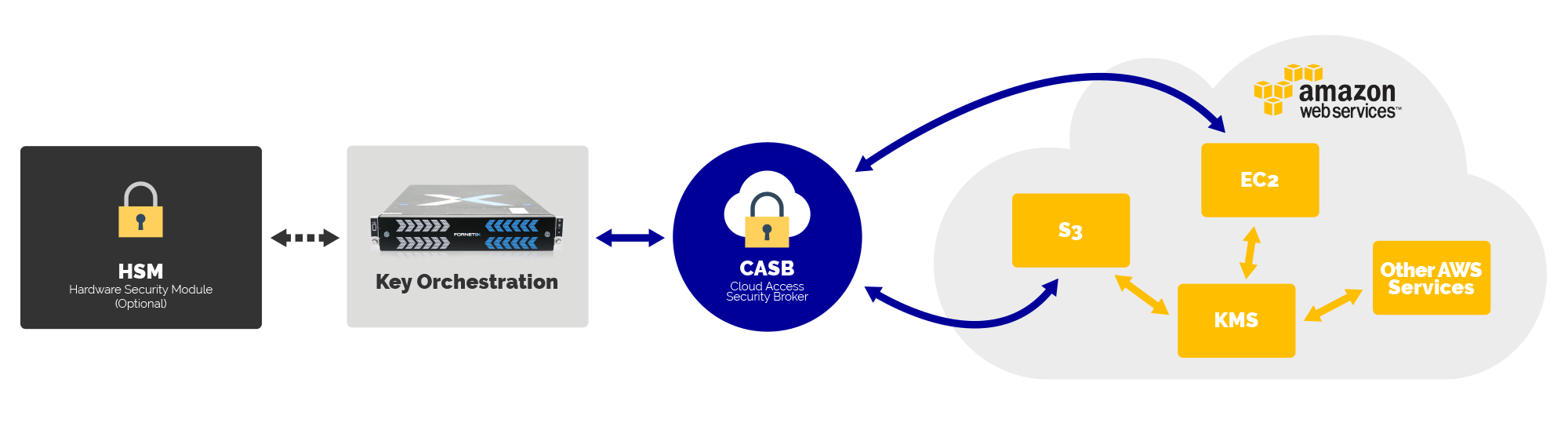
When it comes to securing the data stored within AWS or Azure, a critical decision will be about data security and how you plan to manage your encryption keys. You will need to choose where you store your keys, who has access to them, and who controls the
lifecycle of the keys
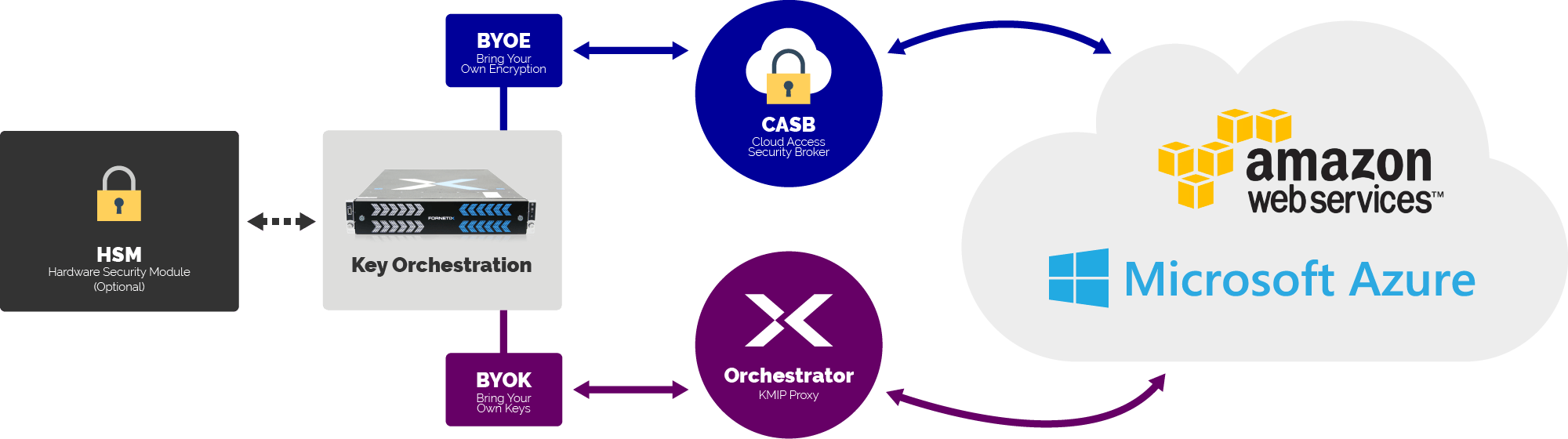
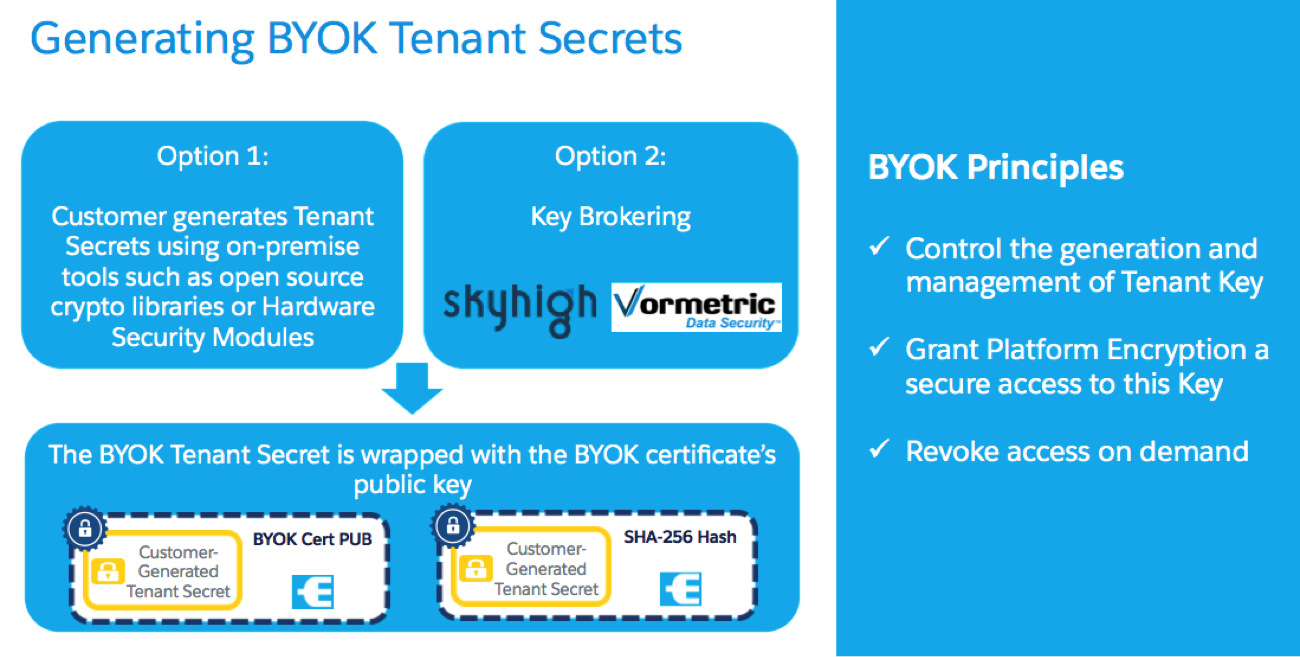
Bring-Your-Own Key (BYOK) and Bring-Your-Own-Encryption (BYOE)
https://www.fornetix.com/encryption-solutions-for-bring-your-own-key-encryption-byok-byoe/
BYOK with SafeNet KeySecure and ProtectApp
https://safenet.gemalto.com/data-encryption/enterprise-key-management/bring-your-own-key-byok/
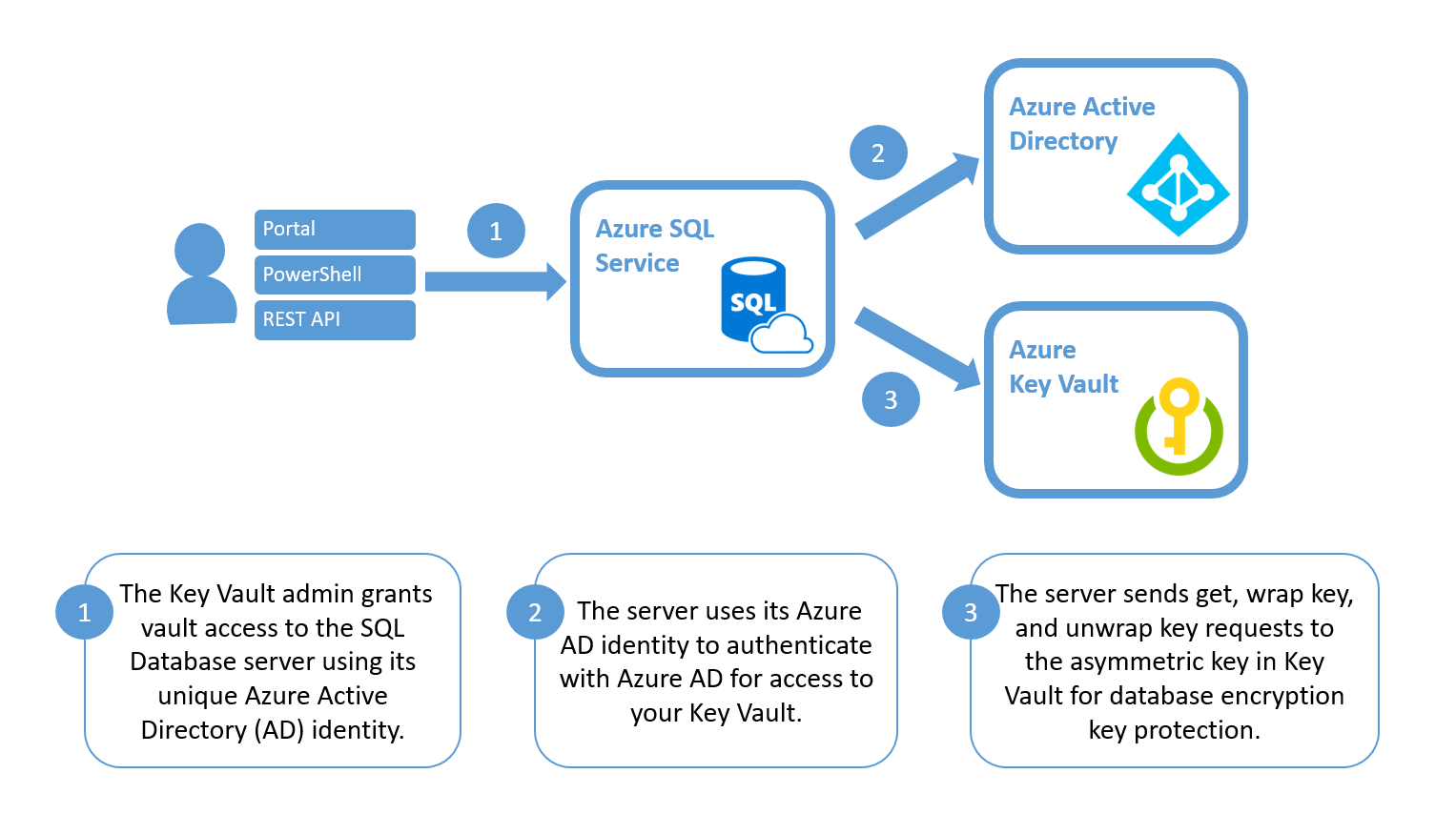
Azure SQL Transparent Data Encryption with customer-managed keys in Azure Key Vault: Bring Your Own Key support
https://docs.microsoft.com/en-us/azure/sql-database/transparent-data-encryption-byok-azure-sql
UpCRM is pleased to announce
: Bring Your Own Key Encryption for Salesforce
https://up-crm.com/upcrm-is-pleased-to-announce-bring-your-own-key-encryption-for-the-salesforce/
Use case
– using customer supplied encryption keys
https://subscription.packtpub.com/book/virtualization_and_cloud/9781788834308/5/ch05lvl1sec44/use-case-using-customer-supplied-encryption-keys
Use Your own Encryption Keys with S3’s Server-Side Encryption
https://aws.amazon.com/blogs/aws/s3-encryption-with-your-keys/
- the role of data encryption as a critical component of any company’s security posture and the potential pitfalls of not using encryption properly. This is magnified when you are talking about storing data outside of customer data centers such as is the case when archiving data to public cloud storage repositories such as Amazon S3, Azure Blob Storage and Google Cloud Storage
It is important to understand that while public cloud providers
are responsible for securing the infrastructure and provide tools for protecting the data stored in their
infrastructures, the user is ultimately responsible for using those tools to secure their data.
I want to continue this blog series by
giving an overview of how encryption at rest
is implemented among the big three public clouds
– Amazon Web Services (AWS), Microsoft Azure and Google Cloud Platform (GCP).
Data-at-rest encryption only since all three providers’ implementation of TLS for encrypting data-in-transit do not differ
greatly
Encryption of object storage data since that is where the largest amount of data
is stored in the cloud. I will probably
be covering services such as block storage, file storage and databases
in the future.
How each provider implements their cryptographic system, including encryption methods, ciphers and key management.
Server-Side vs. Client-Side Encryption
With server-side encryption,
data is not encrypted until
it is transferred to the target, in this case the object storage service. All three providers offer server-side encryption with some differences in implementation details, particularly
in regards to key management
With client-side encryption,
data is encrypted at the source and prior to it being transferred to the target, in this case the object storage service. All three public cloud providers allow for client-side encryption with some offering varying levels of integration.
Encryption Methods
Amazon S3 supports both server-side and client-side encryption with
a number of options for each. Customers have the option of enabling server-side encryption by default for all uploaded objects to S3
For both server-side and client-side encryption, AWS
utilizes AES-256 with Galois Counter Mode (GCM) for any symmetric key encryption operations
GCM provides authenticated encryption by adding a unique tag to the ciphertext which verifies that
the encrypted data has not been tampered with
in any way.
Envelope encryption is used for all client-side options and for all server-side options
except when the customer provides the encryption key.
For server-side encryption, Amazon S3 supports three options:
Amazon S3-managed keys (SSE-S3)
AWS Key Management Service (KMS) managed keys (SSE-KMS)
Customer-provided keys (SSE-C)
https://cloudarchitectmusings.com/2018/03/09/data-encryption-in-the-cloud-part-4-aws-azure-and-google-cloud/
- How to Protect Data at Rest with Amazon EC2 Instance Store Encryption
Encrypting data at rest is vital for regulatory compliance to ensure that sensitive data saved on disks is not readable by any user or application without a valid key. Some compliance regulations such as PCI DSS and HIPAA require that data at rest
be encrypted throughout the data
lifecycle.
To this end, AWS provides data-at-rest options and key management to support the encryption process.
For example, you can encrypt Amazon EBS volumes and configure Amazon S3 buckets for server-side encryption (SSE) using AES-256 encryption.
Additionally, Amazon RDS supports Transparent Data Encryption (TDE).
Disk and file system encryption
You can use two methods to encrypt files on instance stores.
The first method is disk encryption, in which the entire disk or block within the disk
is encrypted by using one or more encryption keys. Disk encryption operates below the file-system level, is operating-system agnostic, and hides directory and file information such as name and size.
Encrypting File System, for example, is a Microsoft extension to the Windows NT operating system’s New Technology File System (NTFS) that provides disk encryption.
The second method is
file-system-level encryption. Files and directories
are encrypted, but not the entire disk or partition. File-system-level encryption operates on top of the file system and is portable across operating systems.
The Linux dm-crypt Infrastructure
Dm-crypt is a Linux kernel-level encryption mechanism that allows users to mount an encrypted file system.
The solution in this post uses dm-crypt
in conjunction with a disk-backed file system mapped to a logical volume by the Logical Volume Manager (LVM)
the relationship between an application, file system, and dm-crypt. Dm-crypt sits between the physical disk and the file system, and data written from the operating system to
the disk is encrypted. The application is unaware of such disk-level encryption. Applications use a specific mount point
in order to store and retrieve files, and
these files are encrypted when stored to disk. If the disk
is lost or stolen, the data on the disk is useless.
https://aws.amazon.com/blogs/security/how-to-protect-data-at-rest-with-amazon-ec2-instance-store-encryption/